

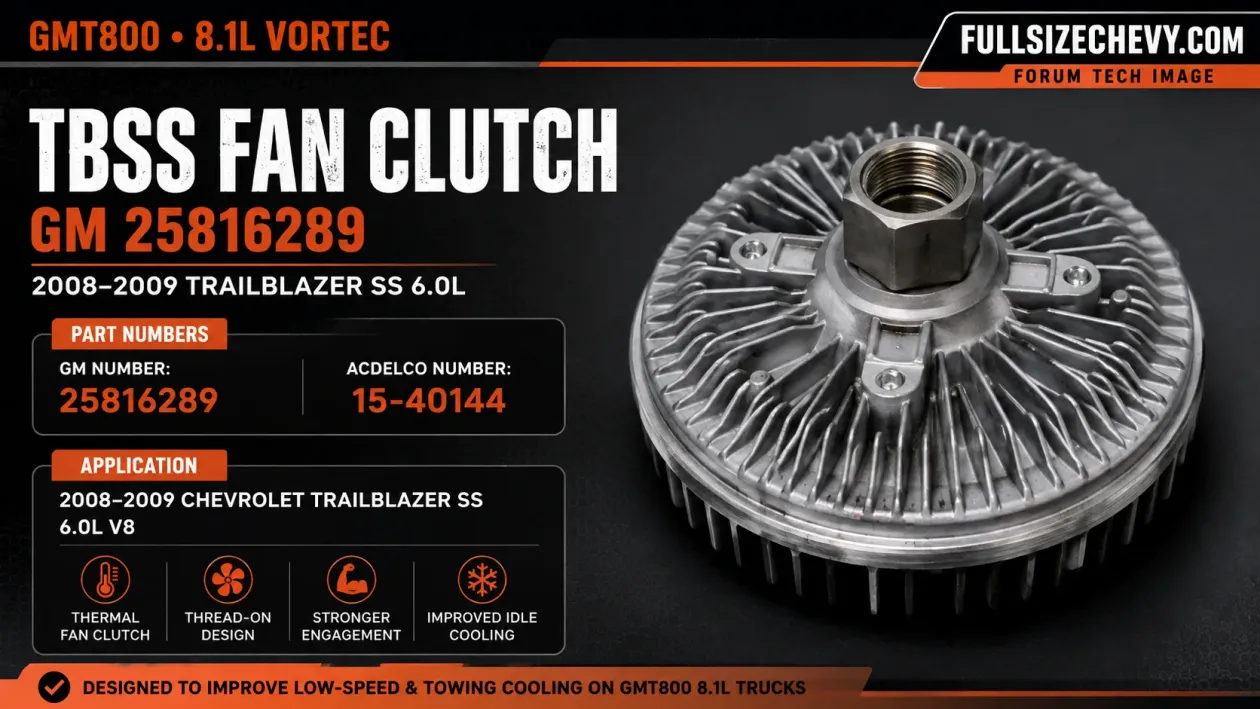
The GMT800 8.1L fan upgrade owners actually run is two parts, not one: the Duramax fan blade (GM 15010202 / ACDelco 15-80690) bolted to the 2008–2009 TrailBlazer thermal fan clutch (GM 25816289 / ACDelco 15-40144). The catalogue data confirms the clutch threads onto the 8.1L water pump and the Duramax fan bolts to it — but the shroud clearance is a check you have to do yourself.
If you own an 8.1L GMT800, you probably did not buy it to commute. These trucks get bought to pull fifth-wheels over mountain passes, drag equipment trailers up job-site grades, haul a 2500-series Suburban full of people and gear across the prairies in July, and idle in a campground with the A/C on while everybody argues about where to park.
That is exactly the duty cycle where a mechanical fan matters most. At highway speed the truck is force-feeding the radiator and condenser whether the fan is doing anything or not. At 15 km/h up a grade with 12,000 lb behind you, or sitting still, the fan is the airflow. If the clutch is tired, the truck will tell you at the worst possible moment.
The common fix in the 8.1L crowd is not another stock fan clutch. It is a two-part swap: the 9-blade Duramax fan with the thermal fan clutch off the 2008–2009 TrailBlazer. This article covers what those parts actually are, what the catalogue data proves about whether they fit an 8.1L, and — just as important — what nobody has published and you will have to measure yourself.
This article covers the 8.1L Vortec (RPO L18) application only. Nothing here should be applied to a 4.8, 5.3 or 6.0 truck — if you are still deciding between engines, start with the GMT800 engine guide and the 6.0 vs 8.1 comparison.
Quick answer: the parts
Fan blade
- GM 15010202
- ACDelco 15-80690
- Factory application: 2001–2005 Silverado / Sierra 2500HD & 3500 with the 6.6L Duramax (LB7 and LLY)
- 9 flexible plastic blades, 4-bolt mounting
Thermal fan clutch
- GM 25816289
- ACDelco 15-40144
- Factory application: 2008–2009 Chevrolet TrailBlazer and GMC Envoy
- Thermal (bimetallic), thread-on, cast aluminium
On the numbers you see posted without the dash: 1580690 is shorthand for ACDelco 15-80690, and 1540144 is shorthand for 15-40144. Retailers list them both ways. Order using the complete GM or ACDelco number. Never order off an abbreviated or half-remembered number — the ACDelco 15-xxxxx range has a lot of close neighbours and a fan clutch that is one digit off will not tell you it is wrong until it is on the truck.
Which trucks this article is about
The 8.1L Vortec ran in GM light-duty vehicles from 2001, and GM’s own parts fitment records for the 8.1L fan blade cover these platforms:
| Vehicle | 8.1L model years (per GM parts fitment) |
|---|---|
| Chevrolet Silverado 2500HD | 2001–2006, plus 2007 Classic |
| Chevrolet Silverado 3500 | 2001–2006, plus 2007 Classic |
| GMC Sierra 2500HD | 2001–2006, plus 2007 Classic |
| GMC Sierra 3500 | 2001–2006, plus 2007 Classic |
| Chevrolet Suburban 2500 | 2001–2006 |
| GMC Yukon XL 2500 | 2001–2006 |
| Chevrolet Avalanche 2500 | 2002–2006 |
For the platform itself, see what years are GMT800. The 8.1L also went into Express / Savana 2500 and 3500 vans and into Kodiak/TopKick medium-duty trucks. Those are outside GMT800 scope and outside this article.
Why 8.1L owners look at the fan in the first place
The complaints that send people down this road are consistent:
- Coolant temperature creeping up on a long grade with a trailer
- Temperature climbing while stopped or crawling, then dropping the moment road speed returns
- A/C that goes lukewarm at idle on a hot day and recovers as soon as you move
- A stock clutch that is 20+ years old and has never been touched
- A 2500-series Suburban, Yukon XL or Avalanche 2500 working near its rating in summer
None of that automatically means the fan is the problem. An 8.1L that overheats has a cooling system that needs diagnosis, not a shopping list — start with the five cooling system failures worth fixing before summer. There is a full checklist further down, and it comes before the parts order for a reason. This swap is an airflow upgrade for a healthy cooling system that is working hard. It is not a repair for a plugged radiator, a bad thermostat, or a water pump on the way out.
How a thermal fan clutch works

A thermal fan clutch is a viscous coupling with a temperature-sensitive control. Inside, silicone fluid transmits torque between an input plate driven by the water pump and the output body the fan bolts to. How much fluid is in the working chamber decides how much of the pump’s speed reaches the fan.
- Low demand. Most of the fluid is parked in the reservoir. The clutch slips heavily, the fan freewheels at a fraction of pump speed, and it costs you very little power and very little noise.
- Rising demand. A bimetallic coil on the front face of the clutch reads the temperature of the air coming out of the radiator — not coolant temperature, not the gauge. As that air gets hotter, the coil rotates a valve that lets fluid into the working chamber. The clutch takes up, and fan speed climbs toward pump speed.
- High demand. With the chamber full, the fan is turning close to its maximum and moving serious air. This is where you hear it.
- Falling demand. As radiator-exit air cools, the coil closes the valve, fluid pumps back to the reservoir, and the fan winds down.
Two practical consequences. First, the clutch reacts to air off the radiator, so it lags coolant temperature — the fan comes up after the coolant has already warmed, not with it. Second, a thermal clutch fails quietly. It does not throw a code. It slowly stops taking up, and you find out on a grade with a trailer.
Duramax fan versus the stock 8.1L fan
| Specification | Stock 8.1L | Duramax upgrade |
|---|---|---|
| GM part number | 15767319 (replaces 15749640) | 15010202 |
| ACDelco number | Not published in the records checked | 15-80690 |
| Blade quantity | Not published | 9 |
| Blade material | Plastic | Plastic, flexible |
| Rotation | Reverse (counter-clockwise) | Reverse (counter-clockwise) |
| Fan bolt circle it mounts on | 3.25 in / 82.6 mm, 4 × M10 × 1.5 | 3.81 in / 96.8 mm, 4 × M8 × 1.25 |
| Original application | GMT800 8.1L, 2001–2007 | 2001–2005 Duramax LB7 / LLY 2500HD & 3500 |
| Current GM availability | Discontinued | Available |
Two things in that table matter more than the rest.
The bolt patterns are different. The stock 8.1L fan mounts on a 3.25 in circle with M10 bolts. The Duramax fan mounts on a 3.81 in circle with M8 bolts. They are not interchangeable on the same clutch. That is not a detail — it is the entire reason this swap is a pair of parts and not just a clutch.
The Duramax fan is the heavier-duty cooling application’s fan, and that is why owners run it. Neither GM nor the aftermarket catalogues publish a blade diameter for it, so treat the airflow gain as the reason owners do the swap rather than as a figure anyone has measured — and check clearance physically, as covered below.
Why the TrailBlazer clutch specifically?

This is the part most write-ups get hand-wavy about. Here is what the catalogue data actually supports.
1. It threads onto the 8.1L water pump. Compared inside a single catalogue’s dataset, the stock 8.1L clutch and the TrailBlazer clutch list the same 1.44 in / 36 mm mount diameter and the same 1.18 in / 30 mm pilot diameter, and both are catalogued as thread-on, reverse-rotation units. A second independent catalogue lists the identical 36 mm / 30 mm pair for the TrailBlazer clutch. That is a genuine dimensional match at the water-pump interface.
2. It carries the bolt pattern the Duramax fan needs. The TrailBlazer clutch has a 3.81 in / 96.8 mm, 4 × M8 × 1.25 fan flange — the same pattern the factory Duramax clutch uses. So the Duramax blade bolts straight to it.
3. It pulls the fan slightly back, away from the radiator. Distance from clutch body to mounting flange:
| Clutch | Distance to mounting flange |
|---|---|
| Stock 8.1L (GM 15712914 / ACDelco 15-4712) | 1.72 in (43.7 mm) |
| TrailBlazer (GM 25816289 / ACDelco 15-40144) | 1.54 in (39 mm) |
| Duramax (ACDelco 15-4964 family) | 1.75 in |
GM’s data and the aftermarket data agree on the 1.54 in figure. Against the stock 8.1L clutch that is about 0.18 in (4.6 mm) of extra room toward the engine — which is exactly the direction you want to move a bigger fan. Note that the TrailBlazer clutch body itself is physically larger overall (7.4 in diameter × 4.27 in tall, against 6.45 × 3.77 for the stock 8.1L unit), so the net position still has to be checked on the truck.
4. It is a current part number, and the stock 8.1L fan is not. GM lists blade 15767319 as discontinued. That alone pushes owners toward a combination built from parts still in production.
What is NOT established: there is no published engagement temperature, engagement RPM or CFM figure for either clutch. Both are catalogued as severe-duty thermal units. Anyone quoting you a specific engagement temperature for a TrailBlazer clutch on an 8.1L is quoting a number that does not exist in the manufacturer data. The honest statement is that this is a severe-duty thermal clutch that accepts a larger fan — not that it has a documented lower switch point.
One more caution worth stating plainly: GM’s catalogue lists 25816289 by model and year — 2008–2009 TrailBlazer and Envoy — not by engine. “TrailBlazer SS clutch” is what the community calls it. Do not assume the number is SS-exclusive.
Correct part numbers, all in one place
The upgrade
| Component | GM | ACDelco | Donor application |
|---|---|---|---|
| Duramax fan blade | 15010202 | 15-80690 | 2001–2005 Silverado / Sierra 2500HD & 3500, 6.6L Duramax LB7 / LLY |
| TrailBlazer thermal fan clutch | 25816289 | 15-40144 | 2008–2009 Chevrolet TrailBlazer / GMC Envoy |
What you are taking off (stock 8.1L)
| Component | GM | ACDelco | Notes |
|---|---|---|---|
| Fan blade | 15767319 (replaces 15749640) | Not published in records checked | Discontinued |
| Fan clutch | 15712914 | 15-4712 | Thermal, thread-on, RPO code GCJ |
Hardware GM lists for these trucks
| Bolt | GM | Size | Use |
|---|---|---|---|
| Fan blade to clutch | 11515756 | M8 × 1.25 × 20, qty 4 | The 3.81 in pattern — the one this swap uses |
| Fan blade (stock 8.1L pattern) | 11516869 | M10 × 1.5 × 18, qty 4 | The 3.25 in pattern — not used after the swap |
Common aftermarket equivalents for the TrailBlazer clutch, if you cannot source the GM number: Hayden 2851, Four Seasons 46049, GMB 930-2530. Quality between aftermarket clutch brands varies more than the boxes suggest — see Downsides.
Will it bolt onto an 8.1L Vortec?
Verdict: bolt-on, with mandatory clearance verification. Not a “buy it and send it” swap.
Here is the honest breakdown, item by item.
| Question | Answer | Basis |
|---|---|---|
| Does the clutch thread onto the 8.1L water pump hub? | Yes — same 36 mm mount / 30 mm pilot as the stock 8.1L clutch, same thread-on style, same reverse rotation | Catalogue dimensional data, two independent sources |
| Does the Duramax fan bolt to the TrailBlazer clutch? | Yes — both are 3.81 in / 96.8 mm, 4 × M8 × 1.25 | Catalogue dimensional data |
| Does the stock 8.1L fan bolt to the TrailBlazer clutch? | No — stock 8.1L pattern is 3.25 in / M10 | Catalogue dimensional data |
| Are spacers or machining needed? | No evidence any are required. No catalogue or manufacturer source indicates a spacer | Absence of contrary data — verify on your truck |
| Does the Duramax fan clear the stock 8.1L shroud? | UNVERIFIED. This is the one you must check. The 8.1L shroud is a different part number from the shroud the Duramax fan ran in | See below |
| Does it clear the radiator? | UNVERIFIED — measure. Depends on your shroud, your radiator and your engine mounts | — |
The shroud problem, stated plainly
The Duramax fan did not grow up inside an 8.1L shroud. GM used different shrouds for every one of these combinations:
| Platform | Engine | Upper shroud | Lower shroud |
|---|---|---|---|
| Silverado / Sierra 2500HD & 3500 | 8.1L (L18) | 15808231 | 15196053 |
| Suburban 2500 / Yukon XL 2500 | 8.1L (L18) | 15088326 | 15005488 |
| Avalanche 2500 | 8.1L (L18) | 15088326 | 15005488 |
| Silverado / Sierra 2500HD & 3500 | 6.6L Duramax (LLY) | 15088324 | 15196054 |
So the pickup 8.1L shroud is a different part from the SUV and Avalanche 8.1L shroud, and both are different from the Duramax shroud. The radiators differ too — the 8.1L pickup radiator (GM 89019156 or 89019168) has a core roughly 37¾ in wide by 19⅜ in tall, where the 6.0L LQ4 truck radiator (22840116) is 34 in by 17¼ in. Different opening, different shroud, different clearance.
Do not skip the clearance check because someone on the internet said it bolts in. It bolts together. Whether it clears your shroud is a measurement, not an opinion.
GMT800 8.1L fitment matrix
| Vehicle | 8.1L years | Stock clutch (15712914) confirmed | Upgrade status |
|---|---|---|---|
| Silverado 2500HD | 2001–2006, 2007 Classic | Yes | Clutch interface confirmed compatible; shroud clearance unverified — measure |
| Silverado 3500 | 2001–2006, 2007 Classic | Yes | Clutch interface confirmed compatible; shroud clearance unverified — measure |
| Sierra 2500HD | 2001–2006, 2007 Classic | Yes (GMC equivalents) | Clutch interface confirmed compatible; shroud clearance unverified — measure |
| Sierra 3500 | 2001–2006, 2007 Classic | Yes (GMC equivalents) | Clutch interface confirmed compatible; shroud clearance unverified — measure |
| Suburban 2500 | 2001–2006 | Yes | Clutch interface confirmed compatible; different shroud from the pickups — measure |
| Yukon XL 2500 | 2001–2006 | Yes (GMC equivalent) | Clutch interface confirmed compatible; different shroud from the pickups — measure |
| Avalanche 2500 | 2002–2006 | Yes | Clutch interface confirmed compatible; shares the Suburban 2500 shroud numbers — measure |
Every row says the same thing, and it is deliberate: the mechanical interface is confirmed across the board because every one of these trucks uses the same stock 8.1L fan clutch. The clearance is not confirmed on any of them, because GM used different shrouds for the pickups, the SUVs and the Duramax trucks.
What to inspect before you order anything
Go look at the truck first. This list will either save you the money or tell you the swap is worth doing.
- Water pump. Grab the fan at 12 and 6 and rock it. Any measurable play at the hub, or any weep from the pump’s drain hole, and the pump is the job — not the fan. You do not want to do this twice.
- Existing fan clutch. Engine off and cold, spin the fan by hand. A healthy thermal clutch turns with noticeable drag and stops within about a turn. If it spins freely like a bicycle wheel, it is done. If it is locked solid, it is also done.
- Shroud. Cracks, missing mounting tabs, a lower half that has been left out after somebody’s radiator job. A fan without a proper shroud does not pull through the core, it stirs air around it.
- Fan-to-shroud clearance as it sits now. Measure it before you take anything apart, so you know what you started with.
- Fan-to-radiator clearance as it sits now. Same reason.
- Engine and transmission mounts. Sagging or collapsed mounts let the whole engine move under torque. That is fan-into-shroud contact waiting for the first hard pull with a trailer.
- Radiator position and condition. Check the core for bent fins, mud, bugs and old sealant. Look at how square the radiator sits in the support.
- Aftermarket radiator? This is the big one. A thicker aftermarket core moves the radiator face rearward, straight toward the fan. If your truck has a non-factory radiator, the factory clearance numbers are meaningless and you must measure.
- Body lift or any previous cooling modification. Anything that moved the radiator, the shroud or the engine changes this equation.
- Condenser. Look at it before the radiator — it is the first thing airflow hits and the first thing that clogs.
Installation
Straightforward job, one genuinely fiddly step, and one step you cannot skip.
- Let the engine cool completely. You will have your hands next to the fan and the radiator.
- Disconnect the battery if you want the fan guaranteed still while you work around it. On an 8.1L there is nothing electrical in the fan itself, but it is cheap insurance.
- Remove the air intake ducting if it is in the way of the shroud or your reach to the fan nut.
- Remove the upper fan shroud. Note how the upper and lower halves clip together — the lower half normally stays with the radiator.
- Hold the water pump pulley so it cannot turn while you break the clutch loose. A pulley-holding tool or a strap wrench works; so does a large screwdriver through the pulley bolts if you are careful not to bend anything.
- Loosen the clutch off the water pump hub. This is a thread-on clutch. Confirm the thread direction before you lean on it — the manufacturer’s general rule is that reverse-rotation (counter-clockwise) clutches use right-hand threads, so they come off counter-clockwise, but verify on the truck rather than assuming. A big fan-clutch wrench and a matching pulley holder make this a two-minute job; without them it is a bad afternoon.
- Lift the fan and clutch out as an assembly, angling it out of the lower shroud.
- Unbolt the stock fan from the stock clutch and set both aside. Do not throw the old clutch out until the new setup is verified.
- Bolt the Duramax fan (15010202) to the TrailBlazer clutch (25816289) using four M8 × 1.25 bolts — GM 11515756 is the correct hardware. Tighten in a cross pattern, evenly. The GM torque specification for these M8 fan-to-clutch bolts is not published in the sources available for this article — the fan-clutch manufacturer’s generic sheet lists 15–18 lb-ft (20–24 N·m) for M10 × 1.5 and 10–12 lb-ft (13–16 N·m) for M6 × 1.0, but does not list M8 × 1.25. Get the GM figure from factory service information rather than splitting the difference.
- Thread the assembly onto the 8.1L water pump hub. The fan-clutch manufacturer’s general guidance for thread-on clutches is 65–75 lb-ft (85–100 N·m) up to 83–113 lb-ft (113–153 N·m) depending on pilot size. Again — confirm against GM service information for the 8.1L before final torque. An under-torqued thread-on clutch can spin off and take the radiator with it.
- Rotate the fan by hand through at least one full revolution — slowly, watching every blade tip.
- Check clearance to the radiator at several points across the sweep.
- Refit the upper shroud and check clearance around the entire circumference, not just at the top where you can see it easily.
- Push the engine fore and aft by hand at the accessory drive to simulate movement on the mounts, and re-check the tightest point.
- Start the engine and listen. Any tick, rub or scrape — shut it down immediately.
- Bring it to full operating temperature and let the clutch come up and back down. Confirm the fan is not contacting anything under load and that the truck’s temperature behaviour makes sense.
Clearance checks — read this before you turn the key
This is the section that decides whether this swap is a good afternoon or an expensive one. A plastic fan blade against an aluminium radiator core wins.
Check all of these with the engine OFF, before the first start:
- Blade tip to shroud, all the way around the circle — top, bottom and both sides. The tightest point is usually not where you are looking.
- Blade face to radiator core, checked at several points across the fan’s sweep.
- Clutch body to anything behind it — upper radiator hose, wiring, the shroud’s upper lip.
- Movement under load. Push and pull the engine on its mounts and re-measure the tightest point. A truck pulling hard moves more than you think.
- Aftermarket radiator thickness. If the radiator is not factory, throw the factory numbers out and measure everything from scratch.
Target: the fan-clutch manufacturer’s general instruction is a minimum of ¾ in (18 mm) between the fan blade and the radiator, shroud, or any engine component. Treat that as the floor, not the goal.
If you cannot get that clearance, stop. Do not trim blade tips, do not cut the shroud, and do not “run it and see”. Put the stock parts back on and go find out what is different about your truck.
What it should sound like
Cold start. A short roar for a few seconds is normal on a thermal clutch — silicone fluid settles into the working chamber overnight, and the clutch is briefly more engaged than it needs to be until it pumps back out. It should clear quickly.
Normal cruising. With the truck moving and the radiator getting plenty of air, the clutch should be mostly disengaged and the fan should be background noise at most.
Under heat and load. A fully engaged mechanical fan on a big-block truck is loud. Pulling a grade with a trailer on a hot day, you will hear it clearly, and you should — that is the fan doing the job you paid it to do. It should quiet down again as the load comes off and the radiator-exit air cools.
When it is a problem, not a feature: a fan that roars constantly at all speeds and temperatures and never winds down is a clutch that has seized engaged. That is a failure, not a characteristic. So is a fan that never comes up at all.
What you should get out of it
Realistic expectations, stated as mechanisms rather than promises:
- More airflow at low road speed. The Duramax fan comes off a heavier-duty cooling application. Below about 60 km/h, and especially at a standstill, the fan is doing nearly all the work, so what it moves per revolution matters most there.
- More air across the A/C condenser. The condenser sits in front of the radiator, so it gets the benefit first. This is the most commonly reported improvement — A/C that holds up better at idle in traffic and at campground crawl speed. If your A/C is weak everywhere and not just at idle, that is a different diagnosis.
- Better coolant temperature control while towing at low speed. Long grades, slow climbs, stop-and-go with a trailer.
- A current-production clutch instead of a 20-year-old one. For a lot of trucks, honestly, this is most of the improvement.
What this article will not tell you: how many degrees it drops your coolant temperature. That number depends on your radiator’s condition, ambient temperature, load, gearing and grade, and nobody has published measured data for this combination on an 8.1L. If someone quotes you a specific temperature drop, ask what they measured it with and on what truck.
Downsides — the honest list
- Noise. More fan engaged means more noise. Some owners like it. Some find it obnoxious on a highway pull.
- Parasitic load. Driving a larger fan takes more power when the clutch is engaged. On a 496 cubic inch engine you are unlikely to feel it, but it is not free.
- Fuel economy while heavily engaged. Same reason. The 8.1L was never going to win awards here regardless.
- Aftermarket radiator fitment. A thicker core is the single most likely reason this swap will not clear on a modified truck.
- Aftermarket clutch quality varies badly. Thermal fan clutches are one of the categories where the cheap box is genuinely a gamble — soft engagement out of the box, or seized within a season. If you are going to do this, buy the GM or ACDelco number, or a name-brand equivalent.
- You might not need it. If your stock clutch is healthy and your cooling system is clean, an 8.1L holds temperature fine. Replacing a good stock clutch with this combination is money for noise.
- The stock fan is discontinued. If you take the stock 8.1L blade off, damage it and change your mind, GM will not sell you a new one. Keep the take-off parts.
Before you blame the fan
An 8.1L that runs hot has a reason. Work this list before ordering parts. Most overheating complaints end somewhere on it.
- Coolant level, checked cold at the reservoir and at the radiator.
- Coolant condition and mix. Old, brown or rusty Dex-Cool moves less heat and eats water pumps. Wrong mix ratio hurts too.
- External radiator blockage. Bugs, mud, gravel-road dust and cottonwood packed into the fins. Look with a light from the engine side.
- Condenser blockage. It sits in front of the radiator and gets everything first.
- Internal radiator restriction. Cold spots across the core with the engine hot, or a big temperature split top to bottom, point to a plugged core.
- Thermostat. Sticking, wrong temperature rating, or installed without the correct orientation.
- Water pump. Play in the shaft, a weeping drain hole, or an impeller that has eroded.
- Pressure cap. A weak cap drops the boiling point and causes overflow. It is a cheap test and a cheap part.
- The stock fan clutch itself. Spin test cold; a freewheeling clutch is a failed clutch.
- Damaged or cracked fan blade. Check for cracks at the hub and for missing balance weights.
- Collapsed lower radiator hose. The spring inside can fail and the hose collapses under suction at RPM.
- Air trapped in the system. Especially after any cooling work on these trucks. An air pocket at the thermostat produces exactly the symptoms of a bad thermostat.
- Ignition timing or a tune. Retarded timing dumps heat into the exhaust and the coolant.
- Transmission heat load. On a 4L80E or Allison truck towing hard, the transmission cooler is in the radiator. A hot transmission makes a hot engine — and fluid and filter service is the cheapest thing you can do about it.
- Restricted airflow to the grille. Bug screens, winter fronts, light bars, oversized plates and aftermarket bumpers.
- Wrong radiator. A 1500-series or 6.0L radiator installed in an 8.1L truck is undersized for the job — the 8.1L uses a physically larger core.
- Previous cooling modifications. Missing shroud halves, deleted air baffles, and “temporary” fixes that became permanent.
Fix what is actually broken first. Then, if the truck is healthy and still working hard, this swap is an airflow upgrade — not a repair.
Towing with the 8.1L
This is the audience for this article, so it is worth being specific about where the upgrade earns its money. If you are still setting the truck up to pull, see the GMT800 tow package retrofit and the Silverado towing guide.
- Enclosed trailers. Big frontal area, lots of drag, and speeds low enough on grades that ram air disappears. Worst-case heat load for a gas truck.
- Fifth-wheel and gooseneck. Heavy, and usually pulled long distances in summer.
- Travel trailers and RVs. Same story, plus you are frequently arriving in the heat of the afternoon and then manoeuvring at walking pace.
- Mountain grades. Sustained full-throttle at 40–60 km/h is where a marginal fan clutch shows itself. This is not a five-minute event — it is twenty minutes of maximum heat rejection with minimum ram air.
- High ambient temperatures. Every degree of ambient comes straight off your margin.
- Campground and yard crawl. Idling and creeping with the A/C on and a trailer behind you. Zero ram air, full A/C head pressure, engine at idle RPM. The fan is the only thing moving air.
- Extended idling with A/C. Waiting to launch a boat, waiting at a weigh scale, waiting for a gate. Same problem.
If your truck’s cooling system is in good shape and your complaints are concentrated in these situations rather than at highway speed, the fan is a reasonable place to spend money. If the truck also runs hot at 100 km/h on level ground with no trailer, the fan is not your problem — go back to the diagnostic checklist.
FAQ
What Duramax fan fits the GMT800 8.1L? The 9-blade Duramax fan, GM 15010202 / ACDelco 15-80690, from 2001–2005 Duramax 2500HD and 3500 trucks. It bolts to the TrailBlazer clutch, not to the stock 8.1L clutch.
Is GM 15010202 the correct Duramax fan? Yes. GM’s own parts records list 15010202 as the engine cooling fan blade for 2001–2005 Silverado / Sierra 2500HD and 3500 with the 6.6L Duramax, with 9 flexible plastic blades and a 4-bolt mount.
Is ACDelco 15-80690 the same fan? Yes. GM’s records show 15010202 and ACDelco 15-80690 as the same part. Some retailers list it without the dash as 1580690 .
What TrailBlazer SS fan clutch should I use? GM 25816289 / ACDelco 15-40144, the thermal fan clutch catalogued for the 2008–2009 TrailBlazer and Envoy. Note that GM lists it by model and year, not by engine.
Is GM 25816289 the correct clutch? Yes, that is the number the community means. It is a thread-on thermal clutch, cast aluminium, 7.22 in maximum diameter, with 1.54 in from the clutch body to the mounting flange.
Is ACDelco 15-40144 the same clutch? Yes. Sometimes posted without the dash as 1540144. Order using the full number.
Does the Duramax fan bolt directly to the TrailBlazer SS clutch? Yes. Both use a 3.81 in / 96.8 mm bolt circle with four M8 × 1.25 fasteners. GM’s own hardware for that pattern is bolt 11515756.
Does the TrailBlazer SS clutch thread directly onto the 8.1L water pump? The catalogue dimensions say yes — it lists the same 1.44 in / 36 mm mount diameter and 1.18 in / 30 mm pilot as the stock 8.1L clutch, and both are thread-on reverse-rotation units. Confirm the thread engages cleanly by hand before applying a wrench.
Will the Duramax fan hit the stock 8.1L shroud? Unverified — and this is the check you cannot skip. GM used different shrouds for the 8.1L pickups, the 8.1L SUVs and the Duramax trucks, so the Duramax fan is not running in the shroud it was designed around. Rotate the fan by hand through a full revolution and check the entire shroud circumference before starting the engine.
Will it fit an Avalanche 2500? The clutch interface is the same as every other 8.1L GMT800 — the Avalanche 2500 uses the same stock fan clutch. But the Avalanche 2500 uses the Suburban 2500’s shrouds (upper 15088326, lower 15005488), not the pickup shrouds, so the clearance check is its own job.
Will it fit a Suburban 2500? Same answer. Same clutch interface, its own shroud part numbers, its own clearance check.
Is it louder than the stock fan? When engaged, yes — a larger fan turning at speed moves more air and makes more noise. At cruise with the clutch disengaged it should not be noticeably different.
Does it rob horsepower? A larger fan takes more power to drive when the clutch is engaged. On a 496 cubic inch engine you are unlikely to notice it, but it is not free, and it costs a little fuel while it is working.
Will it help A/C at idle? That is the most commonly reported benefit, and the mechanism is sound — the condenser is in front of the radiator, so it sees the extra airflow first. No measured data exists for this specific combination, so treat it as a reasonable expectation rather than a guarantee.
Will it fix an overheating 8.1L? No. It is an airflow upgrade for a healthy cooling system, not a repair. Work the diagnostic checklist above first. If your truck overheats at highway speed with no trailer, the fan is not the problem.
Should I use the Duramax clutch instead of the TrailBlazer SS clutch? The Duramax clutch takes the same fan — same 3.81 in / M8 pattern. The reason owners pick the TrailBlazer unit is that it sits about 0.21 in shorter from clutch body to mounting flange (1.54 in vs 1.75 in), which moves a bigger fan slightly further from the radiator. If clearance is tight on your truck, that difference matters. If you have room, either will bolt to the fan.
Related FSC guides
- GMT800 (1999–2006) Silverado & Sierra: the complete owner’s hub
- 8.1L Vortec specs: horsepower, torque and everything on the Vortec 8100
- GMT800 oil type and capacity: 4.8, 5.3, 6.0 and 8.1 Vortec
- 8.1L Vortec spark plugs: ACDelco 41-983 at .045 in
- 8.1L Vortec startup chatter: 5W-30 to Rotella T4 15W-40
- GM 8.1L Vortec L18 drive-by-wire wiring pinouts
- GMT800 vs GMT400 towing: which pulls better?
Post your setup on the forum
If you have run this combination on an 8.1L — or measured it and decided against it — that data is worth more to the next owner than another parts list. Post it in the FullSizeChevy forum with:
- Year, model and platform (Silverado 2500HD, Suburban 2500, Avalanche 2500, and so on)
- Current fan blade part number
- Current fan clutch part number
- What you tow and roughly what it weighs
- Coolant temperature before and after, and where you read it from
- A/C performance at idle, before and after
- Radiator: factory or aftermarket, and how thick
- Measured fan-to-shroud and fan-to-radiator clearance — enough owner measurements would settle this for the whole platform
- Photos of the assembled fan and clutch, and of the shroud clearance
Discuss this in the FullSizeChevy forum — post your symptoms, engine, mileage and what fixed it.
Talk GMT800 with other owners
Post your truck, your build, or the problem you are chasing. Real GMT800 owners in the FSC forum will tell you what actually worked on theirs.
Open the GMT800 Forum →GMT800 Gear
Shop all GMT800 gear →
Find every repair, buying, maintenance, and troubleshooting guide in the GMT800 Owner’s Hub.

