

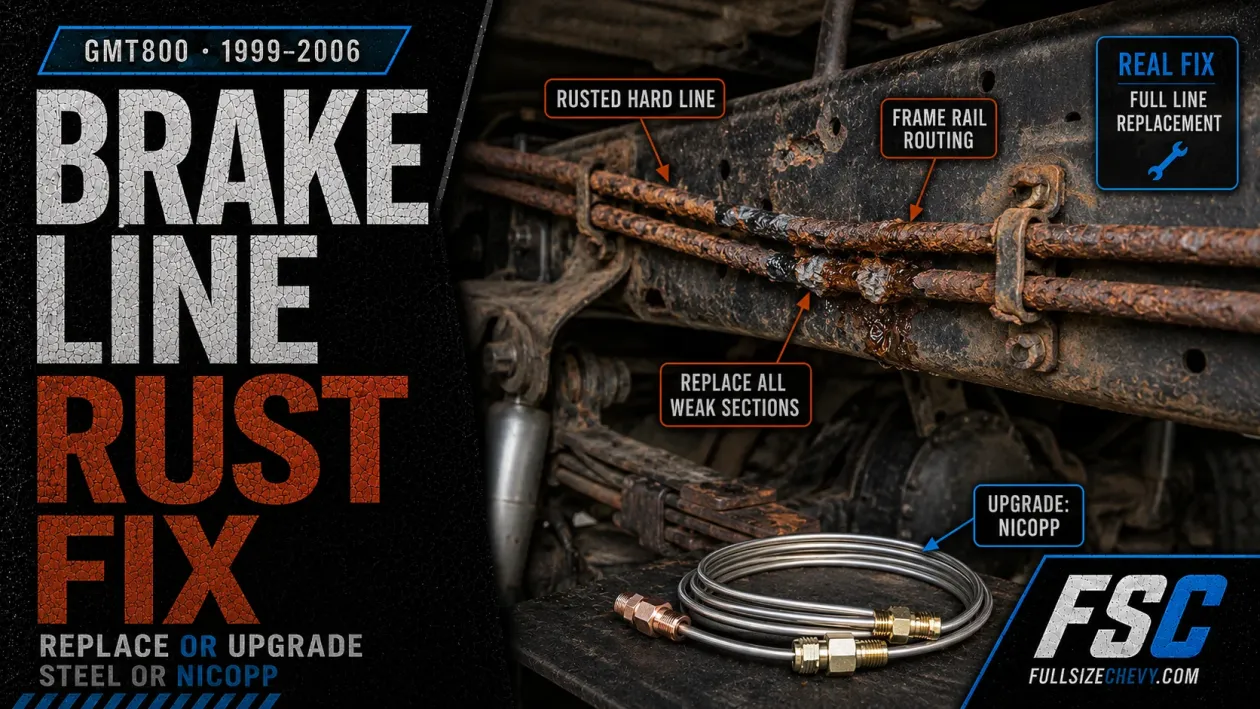
Rusted brake lines are one of the GMT800’s most serious age-related problems — and unlike a squeak or a rattle, this one is a safety issue. A line that finally lets go usually does it when you press the pedal hard, which is the worst possible moment. If your truck lives where they salt the roads, inspect the lines before they fail.
Which trucks this covers
- 1999–2006 Silverado & Sierra, Tahoe, Suburban, Yukon, Avalanche
- Rust-belt and coastal trucks are the highest risk
Warning signs
- Pedal goes soft or to the floor, especially under hard braking
- Visible fluid leak or wet spot along a hard line or at a fitting
- Brake fluid level dropping
- Flaky, scaled, or crusty steel lines on inspection — often worst over the rear axle and along the frame
Inspect before it fails
- Look along the full run of the hard lines — frame rails, over the rear axle, and near the ABS unit and master cylinder.
- Gently probe scaled areas. Heavy surface scale means the wall is thinning; a line that flakes into a pit is on borrowed time.
- Check the fittings and unions — they seize and round off, which affects how you’ll do the repair.
Repair & upgrade options

- Section repair: replacing just a failed segment with new line and unions. Acceptable for an isolated failure, but on a rusty truck the rest of the line is often close behind.
- Full line replacement: the right call when the whole system is scaled. Pre-bent line kits made for the GMT800 save enormous time versus bending your own.
- Stainless steel lines: worth the upgrade in salt country — they resist the corrosion that killed the originals and are a one-and-done fix.
Tools & materials
- Line wrenches (flare-nut wrenches) to avoid rounding fittings
- Tubing cutter and a good double-flare tool if making your own lines
- Pre-bent or stainless line kit, new fittings, fresh brake fluid
- Vacuum or two-person bleeder
Common mistakes to avoid
- Patching one spot on a fully rusted system. If one line rotted through, the others aren’t far behind.
- Using regular open-end wrenches on the fittings and rounding them.
- Reusing old rubber flex hoses that are also age-cracked.
- Skipping a full bleed — air in the system means a soft pedal.
Verify the repair
Bleed the system thoroughly, confirm a firm high pedal that doesn’t sink, and check every new fitting for leaks under pressure before you drive it.
FAQ
Is it safe to drive with a weeping brake line? No — a weeping line can become a blown line without warning. Fix it before driving.
Are stainless lines worth the extra money? In the rust belt, yes — they’re the difference between doing this once and doing it again in a few years.
Discuss it on the forum
Replacing brake lines on your GMT800? Ask about pre-bent vs. stainless kits in the FullSizeChevy GMT800 forum. Related: maintenance checklist and GMT800 common problems. See the GMT800 hub for the full platform overview — every model, engine and repair guide in one place.
Talk GMT800 with other owners
Post your truck, your build, or the problem you are chasing. Real GMT800 owners in the FSC forum will tell you what actually worked on theirs.
Open the GMT800 Forum →GMT800 Gear
Shop all GMT800 gear →
Find every repair, buying, maintenance, and troubleshooting guide in the GMT800 Owner’s Hub.

