

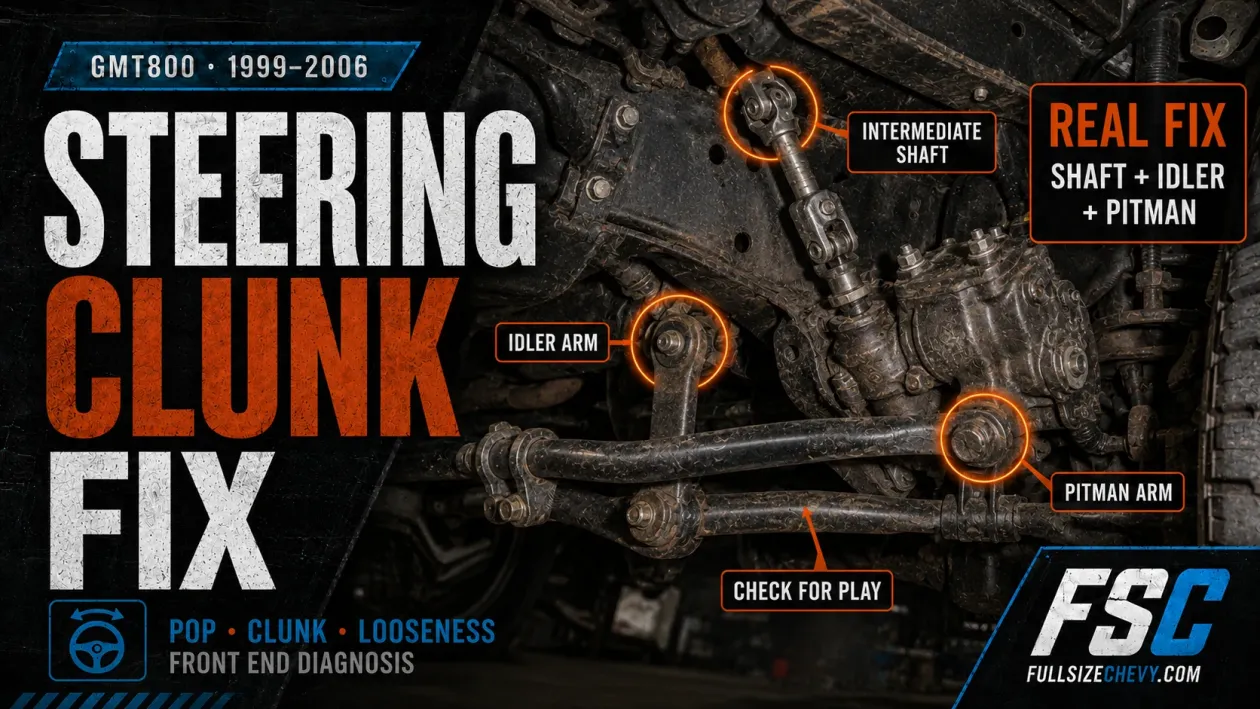
The clunk you feel through the wheel on a 1999–2006 GMT800 when you turn or hit a bump is almost always the intermediate steering shaft. It’s one of the most universal complaints on these trucks. Grease is a band-aid; the permanent fix is the updated shaft. If the noise is more of a wander or looseness at speed, look at the idler and pitman arms instead.
Which trucks this covers
- 1999–2006 Silverado & Sierra, Tahoe, Suburban, Yukon, Avalanche (recirculating-ball steering)
- Affects essentially every full-size GM truck of this era to some degree
Symptoms
- Clunk or knock felt in the steering wheel when turning at low speed or over bumps
- A “notch” or pop right off-center
- Wander, vague on-center feel, or a shimmy — more likely idler/pitman or tie-rod wear
Most likely causes
- Intermediate steering shaft — the splined slip joint dries out and clunks. This is the #1 cause of the wheel clunk.
- Idler arm and pitman arm wear — causes looseness, wander and uneven tire wear more than a sharp clunk.
- Outer/inner tie-rod ends and the centerlink — play here shows up as wander and clunks over bumps.
The intermediate shaft: real fix vs. band-aid

GM issued technical service bulletins on this exact clunk (the 00-02-35-003 series). Early guidance was to lubricate the shaft using GM’s steering-column intermediate-shaft lube kit (GM part 26098419, which includes the grease, a plug and instructions). It quiets the clunk — but on many trucks the noise returns, because grease doesn’t fix a worn slip joint. The lasting fix is replacing the upper intermediate steering shaft with the updated assembly. Confirm the correct shaft part number for your exact truck and steering configuration before ordering.
Diagnosis
- Reproduce it. With the engine running, rock the wheel back and forth a few degrees at a stop and feel for the clunk.
- Have a helper rock the wheel while you watch/feel the intermediate shaft and the steering linkage under the truck — you’ll usually see or feel the lash at the bad joint.
- Check the idler and pitman arms for vertical play; check tie-rod ends for free play. Play there means a linkage job, not a shaft.
Repair options
- Grease kit (temporary): cheap, quiets the shaft for a while — fine as a stopgap.
- Updated intermediate shaft (permanent): the fix that ends the clunk for good.
- Idler/pitman arms: replace in pairs with quality parts if wander/looseness is the real complaint; an alignment after is a must.
Common mistakes to avoid
- Assuming the clunk is a ball joint or strut — feel where it comes from (the wheel vs. the road).
- Greasing the shaft and calling it permanent when the joint is worn out.
- Replacing linkage without an alignment afterward.
Verify the repair
After the shaft or linkage work, the wheel should feel tight on-center with no clunk when rocked at a stop or over bumps. Get an alignment any time you touch the linkage.
FAQ
Is the clunk dangerous? The shaft clunk is a nuisance more than a safety issue, but worn idler/pitman/tie-rods affect handling and tire wear — don’t ignore those.
Will grease really come back? Often, yes. If you want it gone for good, do the updated shaft.
Discuss it on the forum
Got the GMT800 steering clunk? Tell us whether grease held or you went to the updated shaft in the FullSizeChevy GMT800 forum. If the looseness turns out to be linkage rather than the shaft, the GMT800 front-end rebuild thread covers ball joints, tie rods and CV axles. Related: GMT800 common problems and the front-end work. See the GMT800 hub for the full platform overview — every model, engine and repair guide in one place.
Talk GMT800 with other owners
Post your truck, your build, or the problem you are chasing. Real GMT800 owners in the FSC forum will tell you what actually worked on theirs.
Open the GMT800 Forum →GMT800 Gear
Shop all GMT800 gear →
Find every repair, buying, maintenance, and troubleshooting guide in the GMT800 Owner’s Hub.

