


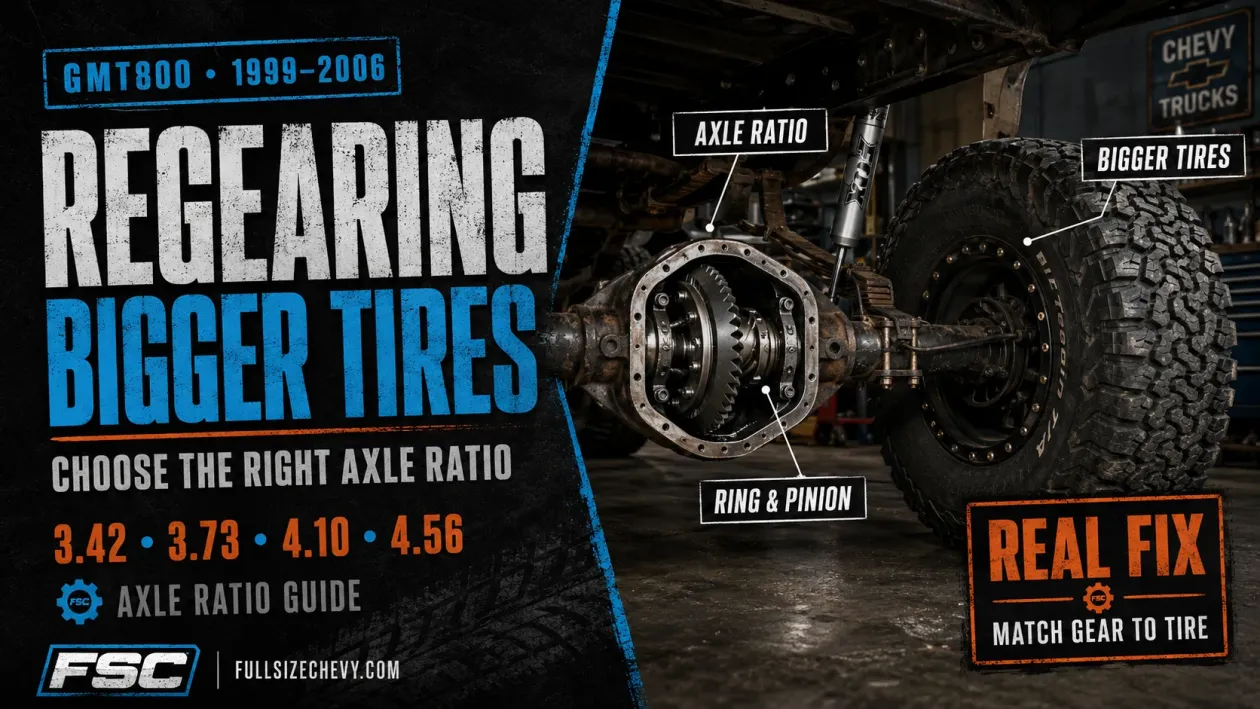
Put bigger tires on a GMT800 and it suddenly feels gutless, downshifts on every hill, and the speedometer reads wrong — because taller tires effectively change your gearing. Regearing the axles restores the performance and towing you gave up. Here’s how to think about picking the right ratio instead of guessing.
Which trucks this covers
- 1999–2006 Silverado & Sierra, Tahoe, Suburban, Yukon, Avalanche
- Trucks running larger-than-stock tires (typically 31″ and up)
Why bigger tires hurt performance
A taller tire has to turn more slowly for the same road speed, which acts like a numerically lower (taller) gear ratio. The result: slower acceleration, worse throttle response, more strain on the transmission (especially the 4L60E), lower highway RPM than the engine wants, and a speedometer that reads slow. The bigger the jump in tire size, the more you feel it.
How to pick a ratio
- Know your current ratio. Decode your factory axle from the RPO code on the glovebox sticker (see the GM axle RPO code guide).
- Know your tire diameter — stock and new.
- Restore your effective gearing. The goal is to choose a numerically higher ratio that offsets the taller tire so the truck behaves like stock again. Common GM truck ratios include 3.42, 3.73 and 4.10 — a bigger tire generally calls for stepping to a higher number.
- Use a gear/tire calculator to match your exact stock tire, new tire, and current ratio to a target ratio. Run the numbers for your specific setup rather than copying someone else’s truck.
Rules of thumb (verify for your truck)

- Small bump (say stock to ~31–32″): you may live with it, but a mild regear sharpens it back up.
- Bigger jump (33s and up): regearing is usually what makes the truck feel right again and protects the transmission.
- Tow or haul with big tires: regearing matters even more — you lost effective torque multiplication at the wheels.
What the job involves
- New ring-and-pinion sets in both axles (front and rear must match on 4×4).
- Proper setup (pinion depth, backlash, preload) — this is a job for someone who sets up gears regularly; a bad setup howls or fails.
- Recalibrate the speedometer for the new tire/gear combo.
Common mistakes to avoid
- Regearing only one axle on a 4×4 — front and rear ratios must match.
- Guessing a ratio instead of running your tire sizes through a calculator.
- Cheap gear setup — bad backlash/preload means noise or failure.
- Forgetting the speedo recalibration and driving around with wrong readings.
FAQ
Can a tune fix the speedo instead of regearing? A tune can correct the speedometer for tire size, but it can’t give back the mechanical gearing — for feel and towing you still want the right ratio.
Will regearing help mileage? With big tires, correct gearing often helps because the engine isn’t lugging — but don’t expect miracles.
Discuss it on the forum
Planning a regear on your GMT800? Post your tire size and current ratio for a gearing recommendation in the FullSizeChevy GMT800 forum. Not sure how big you can go before the regear conversation even starts? The biggest tires on a stock GMT800 1500 thread lists what fits at stock height. Related: GM rear axle RPO codes & gear ratios and best wheels & fitment. See the GMT800 hub for the full platform overview — every model, engine and repair guide in one place.
Talk GMT800 with other owners
Post your truck, your build, or the problem you are chasing. Real GMT800 owners in the FSC forum will tell you what actually worked on theirs.
Open the GMT800 Forum →GMT800 Gear
Shop all GMT800 gear →
Find every repair, buying, maintenance, and troubleshooting guide in the GMT800 Owner’s Hub.

