
Published August 7, 2026 · Updated August 10, 2026 · How we source this
LS Swap Oil Pan Guide: Choose the Right Pan for Your Chassis (Not a “Front-Sump” Label)

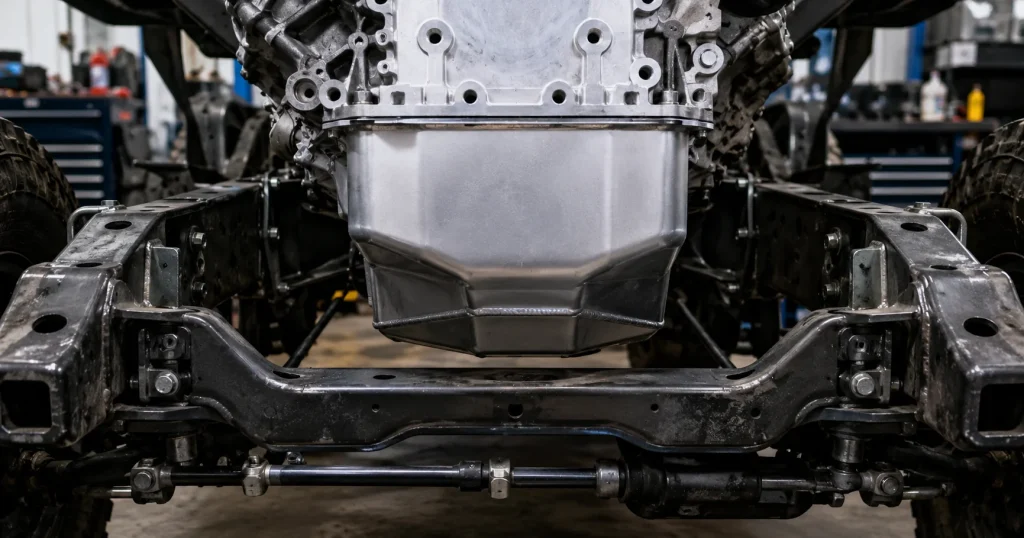
More LS swaps get the oil pan wrong than almost any other single part — and it’s usually because people shop by a two-word label (“front-sump” or “rear-sump”) instead of by what actually matters: their specific chassis. The pan has to clear your crossmember, steering, and — on a 4×4 — your front differential, all while keeping the oil pickup submerged. This guide shows you how to choose correctly, and clears up the single most-repeated myth in LS-swap oil pans.
Critical compatibility warning: never call an oil pan “compatible” without stating the chassis, engine position, mount system, and 2WD/4WD configuration it was verified against. A pan that bolts in perfectly on one truck can foul the crossmember or starve the pump on another.
Why “front-sump vs rear-sump” is the wrong question
The most common bad advice is “Squarebody/OBS trucks need a front-sump pan.” That’s misleading on two counts. First, the pan everyone actually recommends for those trucks — the Holley 302-2 — is a rear-sump wet-sump pan, not a front-sump pan. It’s popular because it adds front clearance for swaps, not because the sump is at the front. Second, “front vs rear” tells you nothing about whether the pan clears your crossmember and steering. Two trucks with the same engine and the “same” pan can have completely different results depending on mount position and 2WD/4WD.
What actually determines whether a pan fits
- Crossmember clearance — where the sump hangs relative to the front crossmember at your engine’s final position.
- Steering linkage — center-link/drag-link or rack location can conflict with the sump.
- Engine and mount position — how far forward/back and how high your motor-mount kit places the engine; this changes everything downstream.
- 2WD vs 4WD front-differential clearance — on a 4×4 the front diff is usually the tightest constraint and dictates a specific sump shape.
- Sump depth and location — has to clear the chassis while keeping enough capacity.
- Pickup compatibility — the pickup must match the pan’s sump so it stays submerged under acceleration, braking and cornering.
- Windage tray / dipstick / gasket — these have to match the pan you choose.
- Stroke — a stroker crank (longer stroke) can hit some pans; check the pan’s stroke limit.
The factory LS pans (and why they often don’t fit older trucks)
| Factory pan | Sump | Why it’s a problem in an older truck |
|---|---|---|
| Car / Corvette (LS1/LS2/LS3) | shallow rear “batwing” | Usually fouls the front crossmember of a Squarebody/OBS and has clearance/pickup issues |
| F-body (Camaro/Firebird) | rear | Deep rear sump; clearance and steering conflicts common |
| Truck (GMT800/900) | center/front-biased | Designed around the factory truck crossmember; may or may not clear a different chassis + swap mounts |
This is why a dedicated swap pan exists: it repackages the sump and pickup to clear an older chassis while keeping the pump fed.
Popular swap pans
Match the pan to your chassis and verify current fitment with the manufacturer before ordering — brands revise applications over time.
- Holley 302-2 — the default swap pan for many full-size truck LS swaps. It’s a rear-sump wet-sump pan designed to add front clearance. Note Holley’s own exclusions: it is not for the LS7 and not for strokes over 3.62″. Comes as a kit (pan, pickup, windage tray, hardware) — use the matched pickup.
- Holley 302-1 — a related front-clearance swap pan; confirm which of the two Holley currently lists for your exact application.
- GM “Muscle Car” pan (e.g., Holley/GM swap pans) — another common street-rod/swap option; verify crossmember and steering clearance for your chassis.
- Aviaid, Moroso, Improved Racing, and similar — offer swap and performance pans (including baffled/higher-capacity options) for specific chassis; good when you need extra capacity or a 4×4-specific shape.
Verify before ordering: if you’re running a stroker, check the pan’s stroke limit (the 302-2 tops out at 3.62″). If you’re building a 4×4, confirm the pan is listed as 4WD-compatible for your front-diff crossmember.
2WD vs 4WD — the difference that trips people up
On a 4×4, the front differential and its crossmember usually sit right where a deep sump wants to be, so 4WD builds need a pan shaped to clear the diff — often a different pan (or a different sump location) than the 2WD version of the same truck. Don’t assume a pan that fit a buddy’s 2WD will clear your 4WD. This is the single most common oil-pan clearance failure on swaps.
By chassis
Squarebody (1973–1987)
Tight around the crossmember and steering. Most builders run a dedicated swap pan (the 302-2 is the common choice) and set final engine position with the mount kit before committing to a pan. On a 4×4 Squarebody, verify front-diff clearance specifically.
OBS / GMT400 (1988–1998)
The car/Corvette pan will foul the GMT400 crossmember — a swap pan is the standard fix. 4WD GMT400s again need front-diff clearance confirmed. Coordinate the pan with your motor-mount kit, since ICT Billet, Dirty Dingo, Hooker and others locate the engine slightly differently.
GMT800 / GMT900 (LS-native)
If you’re staying in a truck that came with an LS, the factory truck pan usually already clears — the pan question mostly comes up when you use a car-engine donor (LS1/LS3) in a truck, in which case you’ll swap to a truck or swap pan and matching pickup.
Oil-pan selection checklist
- Set your final engine position with the motor-mount kit first — pan choice depends on it.
- Confirm 2WD or 4WD and get a pan listed for that configuration.
- Check crossmember and steering clearance with the engine mocked up.
- Match the pickup to the pan’s sump (use the kit’s pickup — don’t mix).
- Confirm windage tray, dipstick and gasket for that pan.
- If stroked, verify the stroke limit.
- Confirm capacity and that the pickup stays submerged.
Reference note: any simplified clearance illustrations we publish are FullSizeChevy reference diagrams, not GM service drawings. For exact dimensions, use the pan manufacturer’s fitment documentation for your chassis.
Next steps
Confirm what engine you actually have with the donor-identification guide, see how the pan fits into the whole build in the LS swap kit guide, and plan the full swap from the LS Swap Hub.
Revision: draft v1 (2026-08-02). Technical-review status: chassis-general guidance verified; exact pan part numbers and per-chassis dimensions should be confirmed against current manufacturer fitment before publishing measurements.
Talk trucks with other owners
Post your truck, your build, or the problem you are chasing and get real answers from full-size GM truck owners in the FSC forum.