

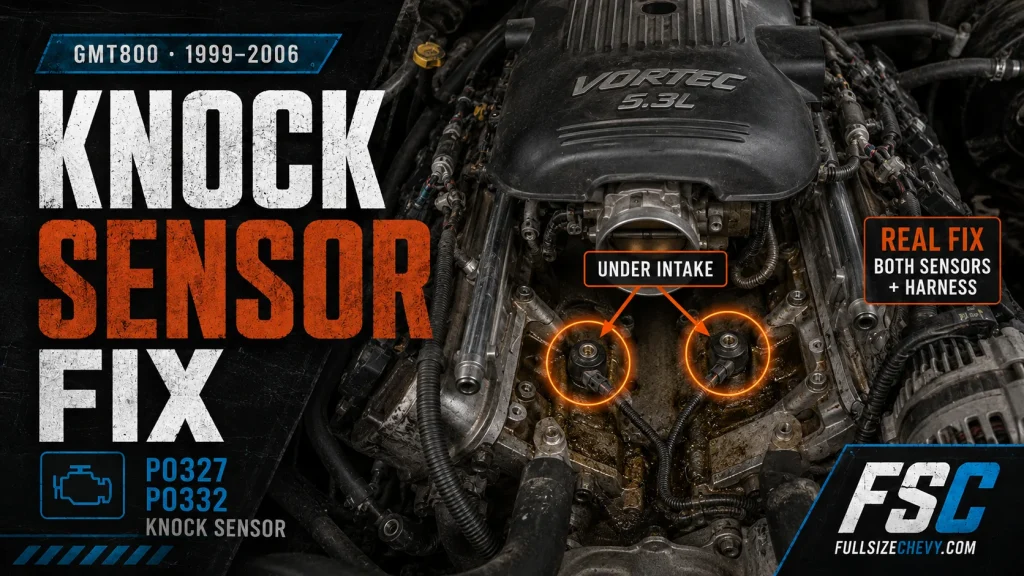
P0327 (bank 1 low) and P0332 (bank 2 low) on a GMT800 are the classic LS knock-sensor codes. The sensors live in the lifter valley under the intake manifold, and water gets down there and corrodes the sensors and their connectors. The codes rarely mean the engine is actually knocking — they mean the circuit has gone bad. Fix it once, correctly, or you’ll be back in there.
Which trucks this covers
- 1999–2006 Silverado & Sierra 1500/2500/3500 (plus 2007 “Classic”)
- Tahoe, Suburban, Yukon, Avalanche, Escalade with the 4.8/5.3/6.0 LS Vortec
- P0327 = knock sensor 1 (bank 1) low; P0332 = knock sensor 2 (bank 2) low
Symptoms owners notice
- Check engine light with P0327, P0332, or both
- Often no drivability change at all — many owners only see the light
- Possible slight loss of timing/economy since the PCM may pull timing when it can’t trust the sensors
Why it happens
The two knock sensors sit in the valley between the cylinder banks, sealed under the intake by grommets. Water from washing, rain through the cowl, or condensation collects in the valley and corrodes the sensors and the connector pins. Because both sensors share the same wet environment, it’s common to see one code, fix only that sensor, and have the other set a month later.
Diagnosis

- Confirm the codes and that it’s not real knock. A true knock-retard event is different from a circuit-low fault — P0327/P0332 low-voltage codes point at the sensor/wiring, not detonation.
- Inspect the connectors. Pull back the harness near the rear of the intake; green/white corrosion on the knock-sensor pigtails is a giveaway.
- Decide to do the job once. Given both sensors live in the same wet valley, replacing both sensors, both grommets and the connector pigtails together is the fix that actually sticks.
Parts and the right approach
- Both knock sensors — use ACDelco / GM Genuine; cheap sensors are a top reason these codes come right back. Confirm the exact part numbers for your engine and year with ACDelco or a GM parts counter.
- New sensor grommets/seals so the valley seals back up.
- Connector pigtails if the pins show any corrosion — don’t reuse crusty connectors.
- Dielectric grease on the reassembled connections to keep moisture out next time.
Access means removing the intake manifold. While it’s off, it’s smart to inspect the intake gasket and clean the valley.
Common mistakes to avoid
- Replacing one sensor. Do both — the second one is already living in the same water.
- Reusing corroded connectors and expecting the code to stay gone.
- Buying the cheapest sensors online. This is the exact job where OEM-grade parts pay off.
- Assuming the engine is knocking and tearing into the bottom end — read the code type first.
Verify the repair
Clear the codes, reassemble carefully, and drive several warm-up cycles. If P0327/P0332 stay gone and the PCM isn’t pulling timing, the job’s done.
FAQ
Can I just tune the codes out? Some owners disable the knock sensors in a tune, but that removes real knock protection. Fixing the sensors is the correct route, especially on a truck you tow or drive hard.
Do I have to pull the intake? Yes on these LS engines — the sensors are under it. Budget the intake gasket in case.
Discuss it on the forum
Fighting P0327/P0332 on your GMT800? Owners in the FullSizeChevy GMT800 forum have done this job — post your engine and what you found in the valley. Related: GMT800 common problems and the GMT800 engine guide.
Talk GMT800 with other owners
Post your truck, your build, or the problem you are chasing. Real GMT800 owners in the FSC forum will tell you what actually worked on theirs.
GMT800 Gear
Shop all GMT800 gear →
Find every repair, buying, maintenance, and troubleshooting guide in the GMT800 Owner’s Hub.