

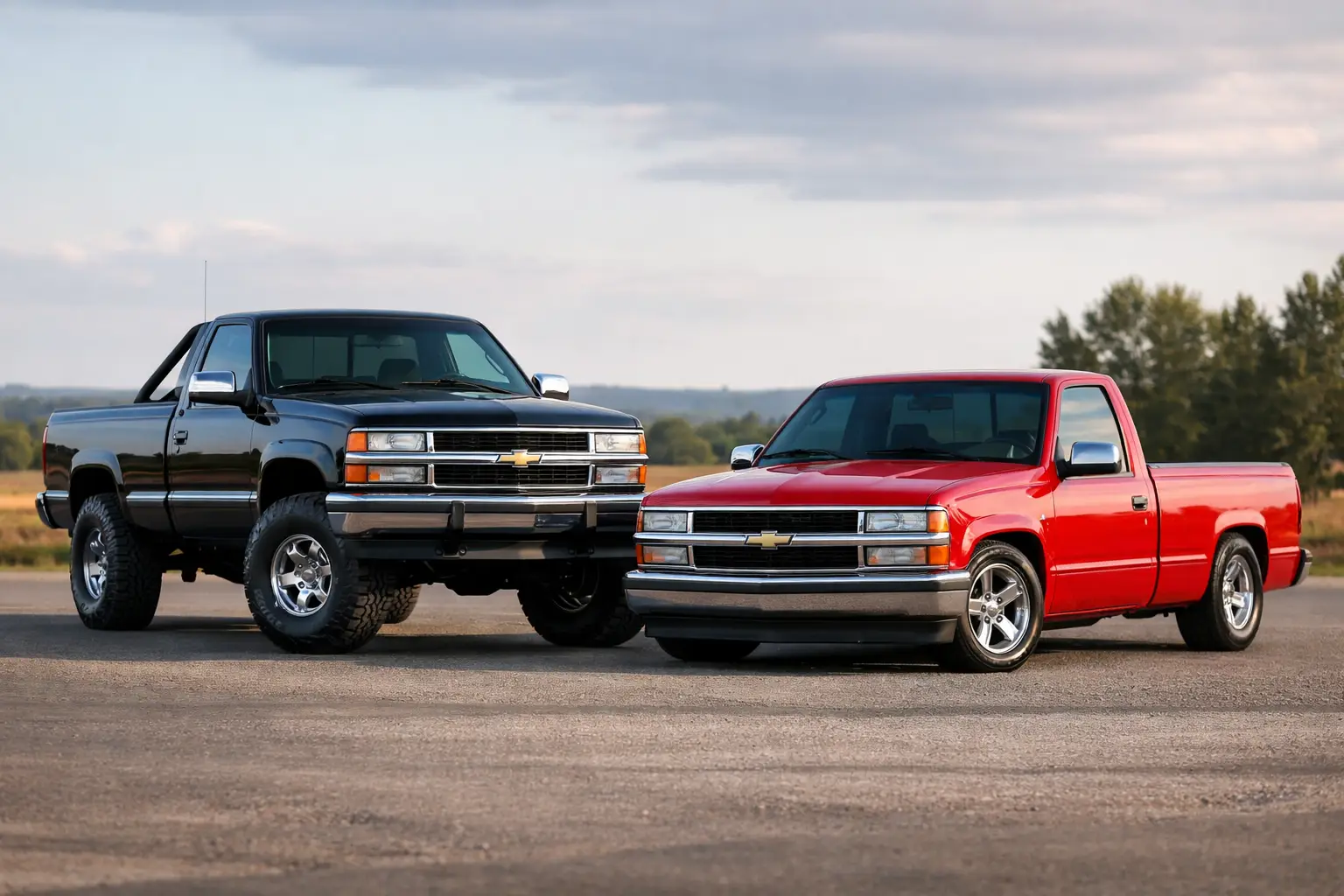
If you are shopping OBS trucks, the chevy k1500 vs c1500 question usually shows up fast – right after you spot a clean GMT400 and start wondering whether you want a lowered street truck or a 4×4 that can still get dirty on the weekend. These two half-tons share a lot of DNA, but they do not drive the same, sit the same, or fit the same kind of build.
For truck guys, this is not just a badge difference. It changes how the truck feels, what parts you need, how much ground clearance you get, and even what kind of money a clean example brings. If you are trying to buy smart, build smart, and keep the culture alive, it pays to know exactly what separates them.
Chevy K1500 vs C1500 at a glance
The simple version is easy. A C1500 is two-wheel drive. A K1500 is four-wheel drive. On GMT400 trucks, that one change affects suspension design, ride height, steering feel, maintenance, and how the truck works in the real world.
The C1500 was built for pavement-first duty. It typically rides lower, feels lighter on its feet, and is easier to turn into a clean cruiser, sport truck, or daily driver. The K1500 brings a transfer case, front differential, and 4×4 hardware to the party. That makes it better in mud, snow, trails, jobsite conditions, and rough back roads, but it also adds weight and complexity.
If your goal is a truck that looks right parked low on a good wheel and tire setup, the C1500 is usually the natural starting point. If you want an OBS that can haul, hunt, camp, or hit nasty weather without drama, the K1500 earns its keep fast.
What the C and K actually mean
On older Chevrolet and GMC trucks, the lettering was straightforward. C meant conventional two-wheel drive. K meant four-wheel drive. By the GMT400 era, that naming still mattered even though a lot of buyers casually referred to all of them as Silverados or just half-ton Chevys.
So when you see a 1990s Chevy 1500 and want to know what it really is, the drivetrain code matters. A C1500 is rear-wheel drive. A K1500 is 4WD. That is the split that drives every other comparison.
Suspension, ride height, and how they feel on the road
This is where the trucks really start to separate.
A C1500 usually rides lower from the factory and feels more settled on pavement. Steering tends to feel a little more direct, and the truck has less of that tall, trucky motion in corners. For a daily-driven OBS, that matters. It is one reason so many clean street builds start life as C1500s.
A K1500 sits higher and feels more substantial underneath you. The added front drivetrain components and 4×4 suspension setup change the way the truck reacts over bumps and in turns. It is not bad by any means. In fact, a well-sorted K1500 has that classic full-size GM feel a lot of us love. But if you drive both back to back, the C truck usually feels simpler and more road-focused.
That difference gets bigger once modifications start. Lowering a C1500 is usually easier and cheaper than taking a K1500 down to the same clean stance. On the flip side, lifting a K1500 feels more natural because that chassis already starts in the 4×4 lane.
Drivetrain and maintenance differences
The C1500 wins on simplicity. Fewer drivetrain components mean fewer things to service and fewer things to wear out. You are dealing with rear-wheel drive hardware instead of a front differential, transfer case, front axle components, and all the extra parts that come with 4WD.
That does not mean a K1500 is fragile. GMT400 4×4 trucks have a strong following for a reason. But when you are buying an older truck, every extra system is one more place for deferred maintenance to hide. Vacuum issues, transfer case problems, worn front end parts, and tired 4×4 actuators can all show up on a neglected K1500.
A clean C1500 is often a little easier to revive and maintain if you are working with a budget. A clean K1500 can be worth the extra effort if you actually need four-wheel traction. That is the key trade-off. Paying for 4×4 makes sense when you use it. If you never leave the pavement, it can just become extra weight and extra repair bills.
Towing, hauling, and real-world use
A lot of buyers assume the K1500 is automatically the tougher truck. That is only partly true.
In low-traction conditions, the K1500 has a clear advantage. Snowy roads, muddy fields, slick boat ramps, and uneven ground all favor the 4×4 truck. If your truck has to work in rough conditions, the K badge matters.
But for everyday hauling and towing on dry pavement, a C1500 can do the job just fine. In some cases, it may even feel more predictable because of its lower ride height and simpler setup. You still need to look at engine, axle ratio, transmission, suspension condition, and whether the truck has the right equipment package. The badge alone does not tell the whole towing story.
For many owners, this comes down to lifestyle. If your truck is a weekend parts runner, cruiser, or occasional tow rig, a C1500 is often enough. If it sees winter roads, dirt access trails, hunting camps, or regular off-pavement work, the K1500 starts looking like the smart money.
Chevy K1500 vs C1500 for builds
This is where the choice gets personal.
If you want a classic OBS sport truck look, the C1500 is hard to beat. It is the better base for a street stance, smoother body lines over a lowered setup, and that clean 1990s Chevy look everybody still stops to check out. Parts availability is strong, and the formula works – drop, wheel and tire package, clean paint, maybe a mild small-block setup, and you have a truck that hits every time.
The K1500 owns a different lane. It is the truck for guys who want an all-terrain build, a period-correct 4×4, or a tougher daily that still looks right with bigger tires and a little lift. The OBS 4×4 stance has become its own thing, especially when the truck keeps a factory-style attitude instead of trying too hard.
Neither one is better in every case. The C1500 usually wins for street presence and lower build cost. The K1500 wins for versatility and that classic full-size 4×4 identity.
Value and what buyers usually pay more for
In many markets, a clean K1500 brings more money than a comparable C1500. Four-wheel drive tends to hold value because demand is broad. Buyers in snow states want it. Outdoor guys want it. Truck guys who like the taller factory look want it.
That said, the C1500 market has its own loyal crowd. Nicely kept short-bed two-wheel-drive OBS trucks have become very desirable, especially when they are clean, uncut, and not full of questionable modifications. If the truck is straight and the specs are right, a C1500 can still pull strong money.
Condition matters more than internet bench racing. A rough K1500 is not automatically a better buy than a solid C1500. Rust, maintenance history, drivetrain health, interior condition, and title status matter more than the badge on the fender.
Which one should you buy?
Buy a C1500 if you want a simpler truck, better street manners, easier lowering options, and a solid daily or cruiser that still feels like a real full-size Chevy. It is the better choice for pavement-focused driving and clean sport truck builds.
Buy a K1500 if you need real 4WD capability, want more ground clearance, or plan to use the truck in weather and terrain where traction actually matters. It costs more to maintain when neglected, but it gives you a wider operating range.
If you are torn, be honest about how the truck will live. A lot of people buy a K1500 because they like the look, then spend years never using 4WD. Plenty of others buy a C1500, then wish they had gone K the first time they deal with snow, mud, or uneven backcountry access.
The right answer is not about bragging rights. It is about fit.
A good OBS truck is a good OBS truck, period. If you find one with a straight body, healthy drivetrain, and honest history, do not let badge obsession blind you to a solid buy. Start with the truck that matches your plans, build it with intention, and keep it on the road where it belongs. That is how you keep these GMT400s alive and keep the culture moving forward.
Talk trucks with other owners
Post your truck, your build, or the problem you are chasing and get real answers from full-size GM truck owners in the FSC forum.
Open the FSC Forum →