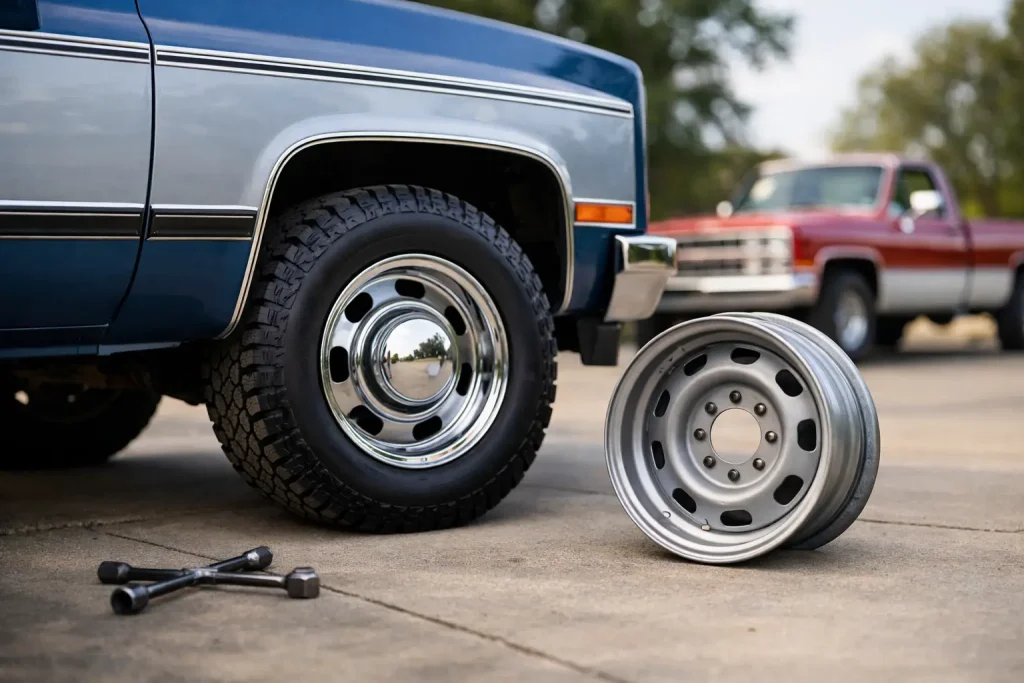
You found a set of wheels, the price is right, and the seller swears they came off an old Chevy truck. Before you load them up, there’s one question that matters more than the story: what bolt pattern is Squarebody Chevy? On these trucks, the answer depends on whether you’re dealing with a 2WD half-ton, a 4×4 half-ton, or a 3/4-ton or 1-ton setup.
If you get that part wrong, the wheels won’t bolt on. If you get it half right, you can still end up with center bore, backspacing, brake clearance, or load rating issues. That’s why bolt pattern talk on Squarebodies needs to be more specific than just “old Chevy truck wheels.”
What bolt pattern is Squarebody Chevy by truck type?
For most Squarebody Chevy half-ton 2WD trucks, the bolt pattern is 5 on 5 inches. That means five lug studs arranged on a 5-inch circle. This is common on C10 models.
For most Squarebody Chevy half-ton 4×4 trucks, the bolt pattern is 6 on 5.5 inches. That setup shows up on K10 models and is one of the most common GM truck bolt patterns ever made.
If you move into heavier-duty Squarebody trucks like many C20, K20, C30, and K30 applications, you’ll usually see 8-lug hubs. Most of those are 8 on 6.5 inches. That pattern carried across a lot of GM 3/4-ton and 1-ton trucks, which is why heavy-duty wheel swaps are often easier to source than people expect.
So the short version is simple. C10 2WD is usually 5×5, K10 4×4 is usually 6×5.5, and the heavy-duty trucks are usually 8×6.5. But “usually” matters here, because Squarebody trucks lived long lives, got axle swaps, and were often built from whatever parts a truck guy had in the shop.
The most common Squarebody Chevy bolt patterns
Here’s the fitment most owners are actually working with when they ask what bolt pattern is Squarebody Chevy.
C10 2WD
Most C10 two-wheel-drive Squarebodies run a 5×5 bolt pattern. That includes a lot of the slammed, street, and sport truck builds people are piecing together today. If you’re buying rally wheels, steelies, or aftermarket wheels for a stock-style C10, this is the first number you need to confirm.
K10 4×4
Most K10 four-wheel-drive Squarebodies run a 6×5.5 bolt pattern. This is the pattern a lot of truck guys know from later GM half-ton 4x4s as well, which opens up more wheel options than some people realize. Still, wheel style doesn’t equal fitment. Just because it’s six-lug doesn’t mean offset and clearance are going to cooperate.
C20 and K20
Most 3/4-ton Squarebody trucks use 8×6.5. These trucks need wheels built for heavier loads, and that matters just as much as the pattern itself. A wheel that technically bolts on but isn’t rated for the truck is not a shortcut worth taking.
C30 and K30
One-ton applications are commonly 8×6.5 as well, though dual rear wheel trucks add another layer of wheel-specific fitment you need to account for. If you’ve got a dually, don’t assume any 8-lug wheel is going to work front and rear without checking width, offset, and mounting style.
Why Squarebody wheel fitment is not just about the lug count
A lot of bad wheel buys happen because somebody counts lug holes and stops there. On a Squarebody, bolt pattern is the first filter, not the last one.
Backspacing plays a huge role, especially on K10s and lifted trucks. Too much backspacing can push the wheel into leaf springs, tie rod ends, or inner fender areas. Too little can create that deep-dish look some guys want, but it also increases scrub radius and can make the truck feel worse on the road.
Center bore can matter too. Many older truck wheels were more forgiving, but hub fit still needs attention. Then there’s brake clearance. If your Squarebody has been upgraded with newer front brakes, spindles, or rear axles, the wheel options that fit a stock truck may not fit yours anymore.
That’s why experienced builders ask a few questions before buying wheels. Is the truck stock or swapped? Is it 2WD or 4×4? Half-ton or heavy-duty? Factory brakes or upgraded brakes? Those details save time, money, and the headache of dragging home wheels that become garage decor.
How to measure a Squarebody Chevy bolt pattern
If you’re not sure what’s under your truck, measure it. That beats guessing every time.
On a 5-lug wheel, you measure from the center of one stud to the far outer edge of the stud directly across from it. On a 6-lug or 8-lug wheel, you can usually measure center-to-center across two opposite studs. Then match that measurement to the pattern. Five inches means 5×5. Five and a half inches means 6×5.5. Six and a half inches means 8×6.5.
It sounds basic, but old trucks get mixed-and-matched constantly. A “C10” may not still have C10 running gear under it. Plenty of trucks have later rear ends, front suspension swaps, or full 4×4 conversions. Measure first and spend money second.
What years count as Squarebody Chevy?
When people say Squarebody Chevy, they usually mean the 1973-1987 Chevy and GMC full-size truck line, with crew cabs, Suburbans, and Blazers stretching into related years depending on the body style and model. The reason this matters for wheel fitment is simple: that generation included a wide range of chassis and drivetrain combinations.
A lowered 1985 C10 and a 1984 K20 might share the same body family, but they are not shopping for the same wheels. Same generation, different hardware.
Common wheel swap questions for Squarebodies
One of the biggest reasons this topic keeps coming up is that GM used shared patterns across multiple generations. That creates opportunity, but it also creates confusion.
For example, many six-lug GM truck wheels from later generations can physically match a K10’s 6×5.5 pattern. But later wheels may have more positive offset than an older truck likes. That can tuck the wheel in too far and create rubbing or steering clearance issues.
The same goes for five-lug setups on C10s. There are wheels out there that share 5×5, but not all of them were designed around classic truck proportions. You can make some combinations work, but you need to know whether you’re building for stock stance, lowered fitment, or a more aggressive look.
Heavy-duty 8-lug swaps are often the most straightforward in terms of pattern matching, but the stakes are higher because these trucks carry more weight. Load rating, wheel construction, and tire choice matter a lot more than style points.
Factory pattern vs swapped axles
This is where Squarebody ownership gets real. A lot of these trucks are no longer factory trucks in the pure sense. That’s not a problem – it’s part of the culture. But it does mean you can’t always trust the badge on the fender.
A C10 might have a later rear axle. A K10 might have had one-ton axles swapped under it years ago. A builder may have converted a truck to a big brake setup that changes what wheels clear. If the truck has changed hands a few times, there’s a good chance the current setup is not what the original brochure said it was.
That’s why asking what bolt pattern is Squarebody Chevy is really the start of the conversation, not the end of it. The better question is, “What bolt pattern is my Squarebody running right now?”
Best way to avoid buying the wrong wheels
Ask for actual measurements, not guesses. If you’re buying online or from a local seller, confirm the bolt pattern, wheel width, diameter, and backspacing. If the seller can’t provide that, assume you’re taking a gamble.
On your own truck, verify the axle type and count the lugs. Measure the pattern. Check for brake upgrades. Look at how much clearance you currently have inside and outside the wheel. If you’re changing ride height, remember that fitment changes with it.
That extra ten minutes in the garage can save you from wasting a weekend and a few hundred bucks.
Squarebodies deserve better than guesswork. Get the pattern right, check the rest of the fitment, and your truck will sit the way it should – built by truck guys, for truck guys, and ready to keep the culture alive.