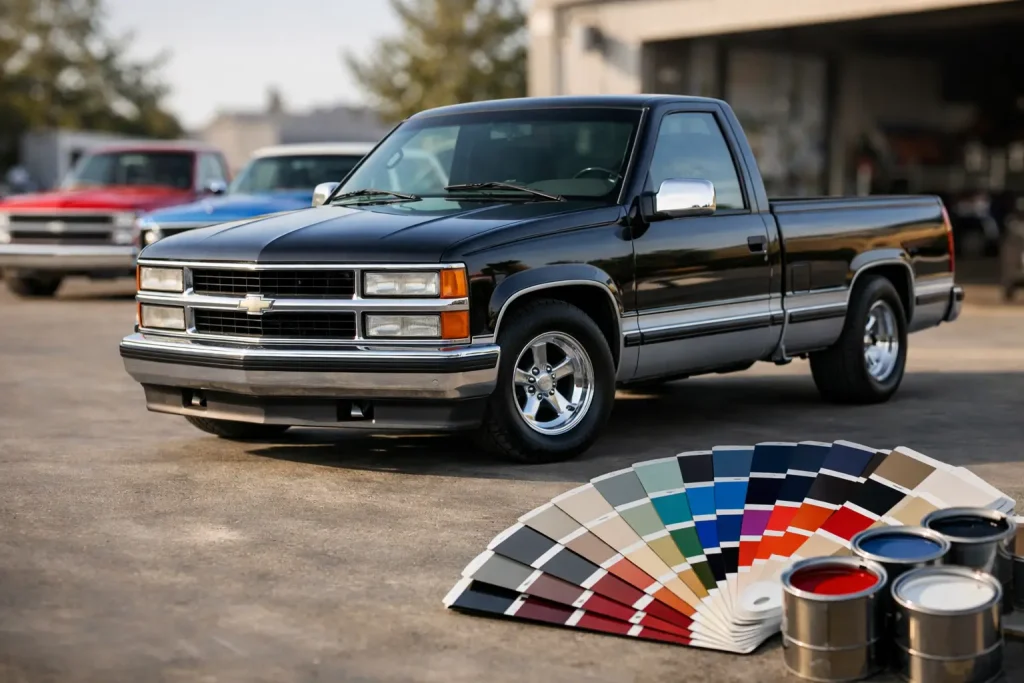
If you have ever stood in a paint supply store staring at faded door-jamb stickers, half-remembered color names, and ten versions of the same blue, you already know why obs chevy paint codes matter. On a GMT400 truck or SUV, getting the right factory color is not just about looks. It is about keeping the truck honest, preserving value, and avoiding that mismatch that jumps out every time the sun hits the fender.
For OBS owners, paint code hunting usually starts when one panel needs attention and turns into a bigger question fast. Is the truck still wearing its original color? Did GM use a two-tone setup? Has 30 years of sun made the factory shade look completely different from what the code says? The answer is usually some mix of all three, which is why knowing how these codes work saves money and frustration.
Where to Find OBS Chevy Paint Codes
On most OBS Chevy trucks, the paint information is found on the Service Parts Identification label, often called the SPID label. From the factory, that label was commonly placed inside the glove box on GMT400 models. If the truck still has its original glove box door and the label has not been peeled off, that is the first place to look.
The label carries a bunch of RPO codes, and the paint code is usually listed with a prefix like BC/CC U followed by a code for the upper body color. If the truck is two-tone, you may also see L for the lower color. That matters because plenty of OBS trucks left the factory with a secondary accent color on the lower body, especially trim packages that leaned harder into the period-correct look.
While that label is out, the rest of those three-character codes are RPOs — axle, transmission, trailering, trim. You can decode the RPO codes on your truck from the same photo and know how it was optioned, not just what color it was.
If the SPID label is gone, things get trickier but not impossible. Some owners track the code through build documentation, old dealership paperwork, or by cross-checking surviving original paint in protected areas like behind trim, under weatherstripping, or inside the cab where sun exposure has been minimal. That is more detective work than direct decoding, but with an older truck, that is part of the game.
How OBS Chevy Paint Codes Are Structured
GM paint codes from this era are usually short alphanumeric identifiers tied to a specific factory color formula. You may see references to WA numbers, U-codes, and color names all connected to the same paint. That is where people get tripped up.
The common shorthand is this: the truck has a body color code on the label, but paint suppliers often want the WA number or the official color name to mix the formula. For example, a truck might be known casually as Victory Red, Indigo Blue, Summit White, or Sportside-era teal, but the paint counter usually needs the exact GM code to pull the right formula.
That also means color names alone are not enough. GM reused some color names over different years, and some shades changed slightly even when the name stayed familiar. If you walk in and say, “It is dark blue,” you are asking for a bad match. If you walk in with the actual code and the model year, you are in much better shape.
Factory Code Versus What Your Truck Looks Like Today
Here is the part a lot of first-time restorers learn the hard way: the correct code does not always equal the correct visual match. Factory paint fades. Clear coat breaks down. Previous owners repaint doors, bedsides, or hoods with whatever was close enough at the time. So even if you have the right code, spraying that formula straight onto one repaired panel can still make it stand out.
That is why a good paint match on an OBS Chevy is part science, part judgment. If the goal is a full respray in the original factory color, the code is your baseline and you are in good shape. If the goal is blending one fender into 25- to 30-year-old paint, the code gets you close, but a skilled paint supplier may still need to tint for what the truck actually looks like now.
This is also where owners need to be honest about the project. A driver-grade repair and a show-level restoration are not the same job. For a clean driver, close and consistent might be the right call. For a full restoration, sticking to the original factory formula matters more.
Common Problems When Matching OBS Paint
The biggest mistake is assuming every truck is still original. Plenty of OBS trucks have had bed swaps, replacement doors, front clip changes, or cheap repaint work over the years. If one panel looks different, it may not be fade. It may be from another truck entirely.
The second mistake is ignoring two-tone layouts. GM used upper and lower paint codes, and if you only decode one, you can end up matching the wrong section. That becomes a bigger issue on trucks with molded trim or lower body accent paint, where the separation line is part of the factory look.
The third mistake is forgetting material differences. Metal and plastic parts do not always reflect color the same way, even with the same formula. On an OBS truck with painted bumper trim, mirrors, or front valance pieces, slight variation can happen even when the code is dead-on.
And then there is age. Old white paint yellows. Reds fade. Blues and greens can flatten out under years of UV exposure. If your truck has lived outside since the Clinton years, the paint code is still right on paper, but your truck may need real-world adjustment.
When a Paint Code Is Enough and When It Is Not
If you are ordering touch-up paint for chips, jambs, hidden areas, or a full repaint back to factory spec, the paint code is usually enough to get started. It gives your supplier the formula they need, and from there the process is straightforward.
If you are repairing a visible panel and trying to blend into existing paint, the code alone may not be enough. That is when a spray-out card, camera matching, or a custom tint becomes worth the extra effort. Some owners hate hearing that because they want a one-number answer, but older trucks rarely work that way.
There is also the quality question. Cheap touch-up products can technically match the code and still look off because the pigment quality, metallic content, or gloss level is wrong. On an OBS build you care about, cutting corners on materials usually shows.
Why Paint Codes Matter for Value and Authenticity
Not every truck owner is building a perfect restoration, and that is fine. But original color still matters. On GMT400 trucks, the right factory shade helps the truck feel period-correct. It looks right with the trim, interior, and stance. That is especially true on special trims and clean survivor builds where authenticity carries weight.
A color change is not automatically bad, but it changes the character of the truck. If you are buying or selling, knowing the original code helps confirm whether the truck still represents what it was born as. For enthusiasts, that is part of the story. For buyers, it can also be a clue about how deep a repaint really went. A truck that changed from one factory red to another is one thing. A truck that was originally emerald green and now wears modern gray with painted-over jambs is a different conversation.
Keeping the culture alive means paying attention to details like this. Paint is one of the first things people see, and when the color is right, the whole truck lands better.
Best Approach Before You Order Paint
Start with the SPID label in the glove box. Verify the model year, read the upper and lower body codes, and write down everything exactly as shown. Then look over the truck carefully for signs of repaint work, swapped panels, or obvious color differences. If the truck seems mostly original and you are doing a full repaint, the factory code gives you a solid path.
If you are fixing one area, compare the truck’s current color in natural light, not under shop lights alone. Check protected paint areas to see what the original shade looked like before years of weathering. If the truck has heavy fade, ask for a custom match instead of trusting the code by itself.
This is one of those jobs where patience pays off. A little extra time spent decoding the label and studying the truck beats paying twice because the first mix looked wrong. Built by truck guys, for truck guys, this kind of detail is what separates a quick patch from a repair you are actually proud of.
The right paint code will not fix bad prep or cheap materials, but it gives your OBS Chevy the right starting point – and on a truck worth keeping, that matters more than ever.