
Published August 2, 2026 · Updated August 3, 2026 · How we source this
Gen III vs Gen IV LS Swap Guide: Engines, Electronics, Controllers and Compatibility

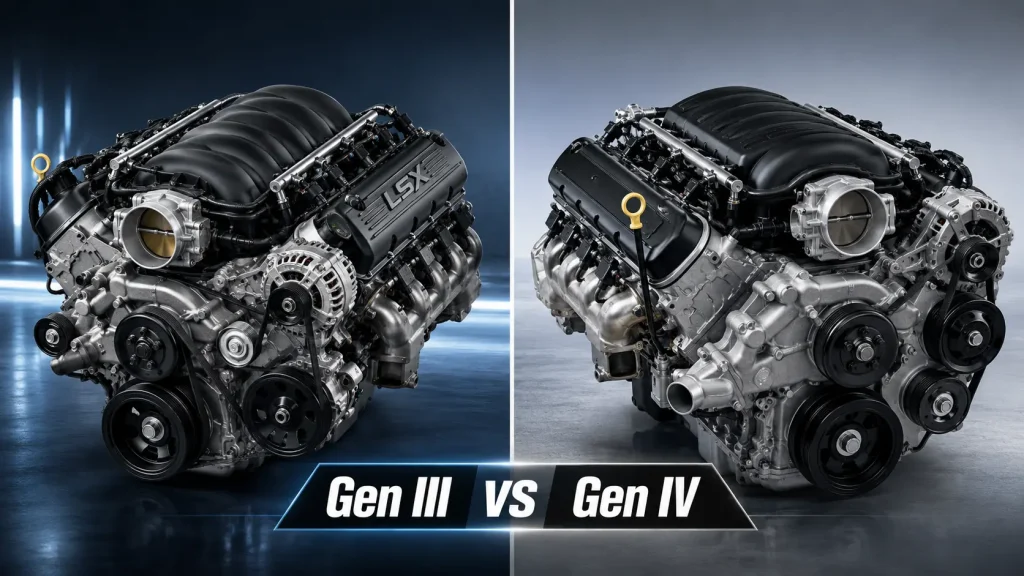
Ask ten people whether you want a “Gen III” or a “Gen IV” LS and you’ll get ten answers — most of them wrong, because the generation label alone does not tell you what your swap needs. This guide compares the two generations the way a builder actually has to think about them: as a stack of separate attributes — physical engine, electronics, crank and cam signals, controller, throttle system, VVT, AFM, heads, fuel, oil pan and transmission — each of which can cross the generation boundary independently. Get these straight and you’ll buy the right donor and wire it once.
Critical rule (read this first): engine generation, electronics generation, controller, crank reluctor, cam signal, throttle type and model year are separate facts. “Gen III” and “Gen IV” are never, by themselves, a compatibility answer.
1. What “Gen III” and “Gen IV” actually mean
The LS family is GM’s Gen III and Gen IV small-block V8. Gen III begins with the 1997 LS1. Gen IV begins with the 2005 LS2, which introduced a revised block casting, external knock-sensor provisions and revised oil galleries while keeping the Gen III fundamentals (deep-skirt block, six-bolt cross-bolted mains). Crucially, Gen III production continued for years after Gen IV arrived — trucks especially. So:
- Model year does not define generation — Gen III and Gen IV were built at the same time.
- Controller type does not define the physical engine — a Gen IV engine can run an early or a late controller depending on the year.
- Throttle type does not define generation — both cable and electronic throttle exist within the LS family.
Transition-year exception: the cleanest proof that “Gen IV = 58x” fails is the LS2 itself. All 2005 LS2 engines use a 24x crank signal with the early E40 controller; in 2006 it splits by platform — the Corvette and CTS-V moved to 58x, but the GTO and SSR kept 24x/E40; by 2007 the family is 58x. Same RPO, same displacement, different electronics. This is why every attribute gets its own column below.
2. Identify the donor before you order a single part
Full method is in the donor-identification guide, but the short version: confirm the RPO (from the SPID label on a complete vehicle), the VIN 8th digit (engine code), the block casting, the crank sensor and reluctor, the cam sensor location (rear vs front cover), the throttle body (cable bracket vs electrical-only), the controller label (service number), and the transmission RPO.
Verify before ordering: an intake cover, a valve-cover badge, or a seller’s “it’s a 6.0” is not proof of engine identity. Photograph the label, the castings, the throttle body, the cam-sensor location and the controller before money changes hands.
3. Complete engine inventory
These tables are generated from our working engine dataset. Displacement, block material, generation, port family and the VVT/AFM status of the major RPOs are verified against GM and corroborating sources; cells marked app-dep (application-dependent) vary by year/platform and must be confirmed for the exact engine.
Gen III engines
| RPO | Disp. | Years | Block | Heads | Throttle | Crank | Cam | Controller | Notes |
|---|---|---|---|---|---|---|---|---|---|
| LR4 | 4.8L | 1999–2007 | iron | cathedral | DBC/DBW* | 24x | 1x rear | P01/P59 | 4.8, not 5.3 |
| LM7 | 5.3L | 1999–2007 | iron | cathedral | DBC/DBW* | 24x | 1x rear | P01/P59 | non-AFM |
| L59 | 5.3L | 2002–2007 | iron | cathedral | DBC/DBW* | 24x | 1x rear | P01/P59 | flex-fuel |
| LM4 | 5.3L | 2003–2005 | aluminum | cathedral | DBW | 24x | 1x rear | P59 | — |
| L33 | 5.3L | 2005–2007 | aluminum | cathedral | DBW | 24x | 1x rear | P59 | high-output |
| LQ4 | 6.0L | 1999–2007 | iron | cathedral | DBC/DBW* | 24x | 1x rear | P01/P59 | early 873 / later 317 heads |
| LQ9 | 6.0L | 2002–2007 | iron | cathedral | DBC/DBW* | 24x | 1x rear | P01/P59 | flat-top pistons (not rec-port heads) |
| LS1 | 5.7L | 1997–2004 | aluminum | cathedral | app-dep | 24x | 1x rear | LS1 PCM (P01) | F-body DBC / Vette DBW |
| LS6 | 5.7L | 2001–2005 | aluminum | cathedral | app-dep | 24x | 1x rear | P01 | higher-flow heads/cam |
* Gen III truck throttle: cable (DBC) on 1999–2002; electronic (DBW, using a separate TAC module + electronic pedal) on 2003–2007. LS1 throttle is by application — F-body cable, C5 Corvette electronic.
Gen IV engines
| RPO | Disp. | Years | Block | Heads | Throttle | Crank | Cam | VVT | AFM | Controller | Notes |
|---|---|---|---|---|---|---|---|---|---|---|---|
| LY2 / L20 | 4.8L | 2007–2017 | iron | cathedral | DBW | 58x | 4x front | no | no | E38 | the GMT900 4.8s (not LC9) |
| LH6 | 5.3L | 2005–2009 | aluminum | cathedral | DBW | 24x→58x | 1x→4x | no | yes | E40→E67 | ’05–’06 24x/E40; ’07–’09 58x/E67 |
| LY5 | 5.3L | 2007–2009 | iron | cathedral | DBW | 58x | 4x front | no | yes | E38 | AFM (all versions) |
| LMG | 5.3L | 2007–2009 | iron | cathedral | DBW | 58x | 4x front | no | yes | E38 | flex-fuel; AFM |
| LC9 | 5.3L | 2007–2013 | aluminum | cathedral | DBW | 58x | 4x front | no | yes | E38 | 5.3L, aluminum, flex, AFM; CP pkg 19258097 |
| LH8 / LH9 | 5.3L | 2008–2012 | aluminum | cathedral | DBW | 58x | 4x front | no | no | E38 | midsize / H3 (non-AFM) |
| LS4 | 5.3L | 2005–2009 | aluminum | cathedral | DBW | app-dep | app-dep | no | yes | verify | TRANSVERSE FWD — major conversion |
| LS2 | 6.0L | 2005–2007 | aluminum | cathedral | DBW | 24x ’05 / split ’06 / 58x ’07 | app-dep | no | no | E40→E38 | ’06: Corvette/CTS-V 58x, GTO/SSR 24x |
| LY6 | 6.0L | 2007–2010 | iron | rectangular | DBW | 58x | 4x front | yes | no | E38 | HD 6.0, VVT, replaced LQ4/LQ9 |
| L96 | 6.0L | 2010–2017 | iron | rectangular | DBW | 58x | 4x front | yes | no | E38/E78 | iron block, alum heads, VVT, E85; CP pkg 19417417 |
| L76 (truck) | 6.0L | 2007–2009 | aluminum | rectangular | DBW | 58x | 4x front | yes | yes | E38 | “Vortec Max” — aluminum, AFM+VVT; NOT the iron L96 |
| LFA / LZ1 | 6.0L | 2008–2013 | — | rectangular | DBW | 58x | 4x front | — | yes | hybrid | HYBRID — high-voltage; not a normal donor |
| LC8 | 6.0L | — | iron | rectangular | DBW | 58x | 4x front | — | — | E78 | CNG/LPG alt-fuel hardware |
| L92 / L9H / L94 | 6.2L | 2007–2014 | aluminum | rectangular | DBW | 58x | 4x front | yes | L94: yes | E38/E67 | truck/SUV 6.2; “L92” also a head label |
| LS3 | 6.2L | 2008–2015 | aluminum | rectangular | DBW | 58x | 4x front | no | no | E38/E67 | gold-standard N/A performance |
| L99 | 6.2L | 2010–2015 | aluminum | rectangular | DBW | 58x | 4x front | yes | yes | E38 | auto-Camaro LS3 w/ AFM+VVT |
| LSA / LS9 | 6.2L | 2009–2015 | aluminum | rectangular | DBW | 58x | 4x front | no | no | E67 | factory supercharged |
| LS7 | 7.0L | 2006–2015 | aluminum | rectangular | DBW | 58x | 4x front | no | no | E38/E67 | dry-sump; Holley 302-2 pan excludes it |
Crate/industrial/hybrid stay separate: LS376/LS427/LSX crate assemblies, industrial L96 and alt-fuel LC8 packages, and the LFA/LZ1 hybrids should never have their specs projected onto ordinary production donors.
4. Crank and cam signals (24x vs 58x, 1x vs 4x)
The crank reluctor tooth count and the cam signal together determine which controller and crank/cam sensors will work. The dominant valid combinations:
| Crank | Cam signal | Cam sensor location | Typical era | Typical controllers |
|---|---|---|---|---|
| 24x | 1x | rear of block | Gen III + early Gen IV | P01, P59, E40 |
| 58x | 4x | front timing cover | later Gen IV | E38, E67, E78 |
Rear cam sensor vs front cam sensor is the fastest visual tell of which era you’re looking at. But confirm it against the reluctor and controller — and remember the transition engines are Gen IV with 24x: the 2005 LS2 and 2005–2006 LH6 both use 24x/1x with the E40, and the 2006 LS2 is even split by platform (Corvette/CTS-V 58x, GTO/SSR 24x). Sensor connector colour is a clue, not proof: it has misled plenty of builders. Reluctor-conversion modules exist to run a 58x engine on a 24x controller (and vice versa), but they add complexity and limitations — matching the engine to its native controller is simpler.
5. Controllers: P01, P59, E40, E38, E67, E78
| Controller | Gen | Crank/Cam | Throttle | Trans control | Best for |
|---|---|---|---|---|---|
| P01 / P59 | III | 24x / 1x | DBC (or DBW + separate TAC) | integrated 4L60E/4L80E | simplest Gen III truck/car swaps |
| E40 | IV (early) | 24x / 1x | DBW (integrated) | 4-speed | 2005 LS2, 2005–06 LH6, 2006 GTO/SSR |
| E38 | IV | 58x / 4x | DBW (integrated) | external TCM (T42/T43) | most Gen IV truck/SUV swaps |
| E67 | IV | 58x / 4x | DBW (integrated) | external TCM | VVT / performance / supercharged |
| E78 | IV | 58x / 4x | DBW (integrated) | external TCM (T43) | later HD 6.0 (L96/LC8) |
Do not treat a family name as a part number, and do not assume interchangeability from connector colour — two controllers can share a colour and have different pinouts, operating systems and feature support. The original matched controller is usually the safest starting point because it already pairs with that engine’s signals, throttle and transmission. Conversion to a different controller is justified when you’re consolidating a fleet of parts, gaining a feature (e.g., 6-speed control), or the original is missing — but it’s a deliberate project, not a default. No pinout should be published or wired from an internet “blue plug/green plug” chart; use factory service information for the exact service number, application and year.
6. Drive-by-cable vs drive-by-wire
Drive-by-cable (DBC) uses a physical throttle cable and is the simplest path in an older truck — no pedal sensor, no throttle-actuator control to wire. Drive-by-wire (DBW / electronic throttle) uses an electronic pedal and throttle body; early Gen III DBW (and Gen III trucks from 2003) used a separate TAC (throttle actuator control) module, while Gen IV integrated it into the ECM. DBW needs a matching pedal, the correct controller strategy, and clean brake/cruise inputs.
DBW is not inherently inferior — it gives better idle control, traction/cruise integration and drivability, and every 6.2L and most late truck engines are DBW. The mistake to avoid: thinking you can “tune out” drive-by-wire. Converting DBW to DBC is a hardware conversion — cable throttle body, matching TPS, IAC-capable intake or adapter, harness changes and PCM strategy. A calibration cannot replace missing hardware.
7. VVT (variable valve timing)
VVT appears on many Gen IV engines — the 6.2L L92/L9H/L94 and L99, the 6.0L LY6 and L96 (per GM’s own documentation), and the aluminum L76 truck (“Vortec Max”). It uses a cam phaser, a specific front cover and a controller that supports phaser control (E67 and VVT-capable E38 calibrations). You can retain VVT for factory drivability, electronically disable it, or mechanically delete it with a non-VVT cam/cover/timing set — deletion simplifies the swap but gives up the drivability benefit.
8. AFM / DOD (cylinder deactivation)
Active Fuel Management (AFM), earlier called Displacement on Demand (DOD), shuts off four cylinders under light load. AFM engines have specific lifters, a valley cover with the AFM solenoid manifold, and a lifter-oil-manifold assembly. You can retain it, electronically disable it, or mechanically delete it (non-AFM lifters, delete valley cover, delete kit + tune). AFM lifter failure is the #1 failure point on the Gen IV 5.3L engines that have AFM — which includes the LY5, LMG, LC9 and LH6.
Never assign AFM failure to a non-AFM engine. The Gen III LM7, LR4, LQ4 and LQ9 have no AFM lifters — they cannot suffer an AFM lifter failure. The 4.8L LY2/L20, the HD 6.0L L96/LY6, and the LH8/LH9 are also non-AFM. Confirm presence before assuming.
9. Cylinder heads and intake compatibility
Two port families dominate: cathedral-port (all Gen III, the 4.8/5.3 Gen IV, and the LS2) and rectangular-port (the 6.0L Gen IV truck engines, the 6.2L L92/LS3 family, and LS7). They are not interchangeable without matching the rest of the top end.
“L92” is both an RPO and, loosely, a head/port label — say which you mean. Bolting rectangular-port heads onto a cathedral-port engine changes the intake manifold, injector height and pushrod length, so it is not a bolt-on in isolation. The production LQ9, for the record, uses cast-iron cathedral-port heads — not LS2 or rectangular heads.
10. Fuel systems
LS fuel systems split into return and returnless designs, with regulated pressure either at a rail-mounted regulator, a Corvette-style filter/regulator, or in-tank. Later trucks use PWM (pulse-width-modulated) fuel-pump control, and flex-fuel engines add a fuel composition sensor. Match your rail style, injector data, pump flow, hose/fitting ratings and filter placement to the engine you chose.
Separate chassis-general principles from model-year truck specifics: the fuel pressure a rail wants is a general fact; what your OBS or Squarebody tank, sender and pump module actually provide is year- and engine-specific. See the OBS wiring & fuel guide for the GMT400 specifics.
11. Oil pans and oiling
Oil-pan selection is chassis-driven, not a “front-sump vs rear-sump” label. The correct pan depends on the crossmember, steering linkage, engine and mount position, sump depth and location, pickup and windage-tray compatibility, dipstick, stroke, and 2WD vs 4WD front-differential clearance. A popular swap pan is the Holley 302-2 — which is a rear-sump wet-sump pan built to add front clearance, and which Holley excludes for the LS7 and for strokes over 3.62″.
Critical compatibility warning: never call an oil pan “compatible” without stating the chassis, engine position, mount system and 2WD/4WD configuration it was verified against.
12. Accessory drives
Accessory-drive spacing differs between truck, Corvette and F-body/car layouts, plus application variants, and each positions the water pump, balancer, alternator, power steering, A/C and tensioner differently. That changes clearance to your frame, steering box, hood, radiator and fan. Truck accessory drives are usually the easiest starting point for a truck swap because the spacing already suits a truck engine bay. Where you need exact numbers, measure from a consistent datum (block face or crank centerline) rather than repeating informal spacing labels.
13. Transmissions
Behind any LS you’ll see the 4L60E family (4L60E/4L65E/4L70E, good to roughly 400–450 hp), the heavy-duty 4L80E/4L85E, the six-speed 6L80E/6L90E, or a manual (T56/TR6060, or an adapted factory manual). Older three-speeds (TH350/TH400) and the 700R4 can sit behind an LS with the right flexplate/spacer but give up electronic control.
“Bolts up” is not a complete verdict. Separate the mechanical interface (bellhousing, crank flange, converter pilot, flexplate/spacer, input shaft) from the control side (TCM, VSS/speed sensors, calibration) from the install (crossmember, driveshaft length, transfer case, tunnel). The six-speeds in particular need a compatible T43 control strategy and network — they are not a bolt-in for an engine-only E38 without that plan.
14. Chassis notes (older trucks)
Each destination chassis has its own crossmember, steering, differential and tunnel realities — and 2WD vs 4WD changes oil-pan and crossmember clearance within every one. Dedicated chassis guides are in progress for Advance Design, Task Force, 1960–66 and 1967–72 C/K, Squarebody, GMT400/OBS, and GMT800 replacement/conversion work. Until then, the platform-specific fitment notes live in the main LS Swap Guide and the OBS/GMT400 hub.
15. Wiring and calibration
A running LS needs a defined set of circuits: constant and ignition power, clean grounds, relays and fusing, fuel-pump control, fan control, an OBD-II port, brake input, VSS, tach and speedometer feeds, A/C request/clutch, alternator, MIL, serial data, and — for automatics — transmission wiring. On the calibration side you’ll address VATS/security, injector and MAF data, transmission segment, gear/tire, fan and emissions readiness.
Do not wire from generic colour instructions. Work from the factory schematic and connector views for your exact donor and controller. The OBS wiring guide shows the approach in detail.
16. Gen III vs Gen IV: the practical decision table
| Factor | Gen III | Gen IV |
|---|---|---|
| Donor cost | lowest (LM7/LQ4 everywhere) | low–moderate |
| Wiring complexity | simplest, esp. cable-throttle P01/P59 | more (DBW, GMLAN, separate TCM) |
| Throttle | DBC common (esp. ’99–’02 trucks, F-body) | predominantly DBW |
| VVT / AFM | none to deal with | present on many; retain or delete |
| Power potential | excellent (iron 6.0 loves boost) | excellent (rec-port heads flow more N/A) |
| 6-speed auto | no (4-speed era) | yes (6L80E/6L90E) |
| Best use case | simplest reliable budget swap | modern drivability, big N/A power, 6-speed |
| Main trap | assuming all are cable (’03+ trucks are DBW) | assuming all are 58x (LS2/LH6 aren’t) |
Neither generation is universally better. A cable-throttle Gen III is the fastest path to a running truck; a Gen IV gives you modern drivability, a six-speed and stronger factory heads. Choose by what you value, then verify the specific engine’s attributes.
17. Recommended complete donor packages
Each package states the assumed combination so you can shop against it. Confirm the exact donor before buying — these are starting specifications, not guarantees.
- Lowest-cost reliable truck swap: 1999–2002 LM7 5.3L (Gen III, iron, cable throttle) + 4L60E + P01/P59, returnless truck rail → into a GMT400/Squarebody. Simplest wiring, cheapest donor.
- Simple DBC Gen III: 1999–2002 LQ4 6.0L + 4L80E + P59 (cable), truck accessory drive → torque-focused OBS/Squarebody build.
- Factory DBW Gen III: LS1 (C5 Corvette, DBW) + 4L60E + LS1 PCM + matching pedal/TAC → lighter aluminum car engine, electronic throttle done right.
- Gen IV with VVT retained: L92 6.2L + 6L80E + E38/E67 (+ T43) with pedal and VVT hardware → modern power and drivability; plan the six-speed control.
- Gen IV without AFM: the cleanest non-AFM Gen IV donors are the LH8/LH9 (H3/Colorado 5.3) or an HD 6.0 (L96/LY6). Note the common 5.3 truck donors (LY5, LMG, LC9) all have AFM — if you use one, plan an AFM mechanical delete (non-AFM lifters + valley cover + delete tune) with an E38 and external TCM.
- 6L80E/6L90E swap: any 58x Gen IV engine + 6L80E/6L90E + E38/E67 + T43 control strategy → the network/TCM plan is mandatory, not optional.
- Heavy-duty towing: L96 iron 6.0 (VVT) + 6L90E + E38/E78 → durable HD combination.
- Squarebody 4WD package: LM7/LQ4 + 4L80E + swap pan verified for 4WD front-diff clearance + truck accessory drive.
- GMT400 street truck: LQ4/LS3 depending on budget + 4L60E/4L80E + standalone harness → see the OBS wiring guide.
- GMT800 “replacement/upgrade”: stay in-family (LQ9 or L92/LS3) matched to the truck’s existing 24x/58x and controller — confirm reluctor before buying.
Callout legend & review status
Critical compatibility warning — could cause a wrong purchase or unsafe build. Verify before ordering — confirm on your specific donor. Application-dependent — value legitimately varies by year/platform. Transition-year exception — the rule breaks here.
Revision: draft v2 (2026-08-02). Core engine facts — generation, displacement, block material, port family, crank/cam era, throttle type, and VVT/AFM for the major RPOs — verified against GM and corroborating sources (L96 VVT per GM Powered Solutions; LS2/LH6 reluctor transitions and L76 “Vortec Max” spec corroborated). Still pending GM Service Information: production ECM/PCM service numbers, hardware numbers and pinouts, and a few export/hybrid RPOs (L77, L98, LFA, LZ1). Generated from the FSC LS engine and controller datasets.
Keep going: plan the whole build from the LS Swap Hub, and post your donor questions in the FSC forum before you buy.
Talk trucks with other owners
Post your truck, your build, or the problem you are chasing and get real answers from full-size GM truck owners in the FSC forum.
Open the FSC Forum →